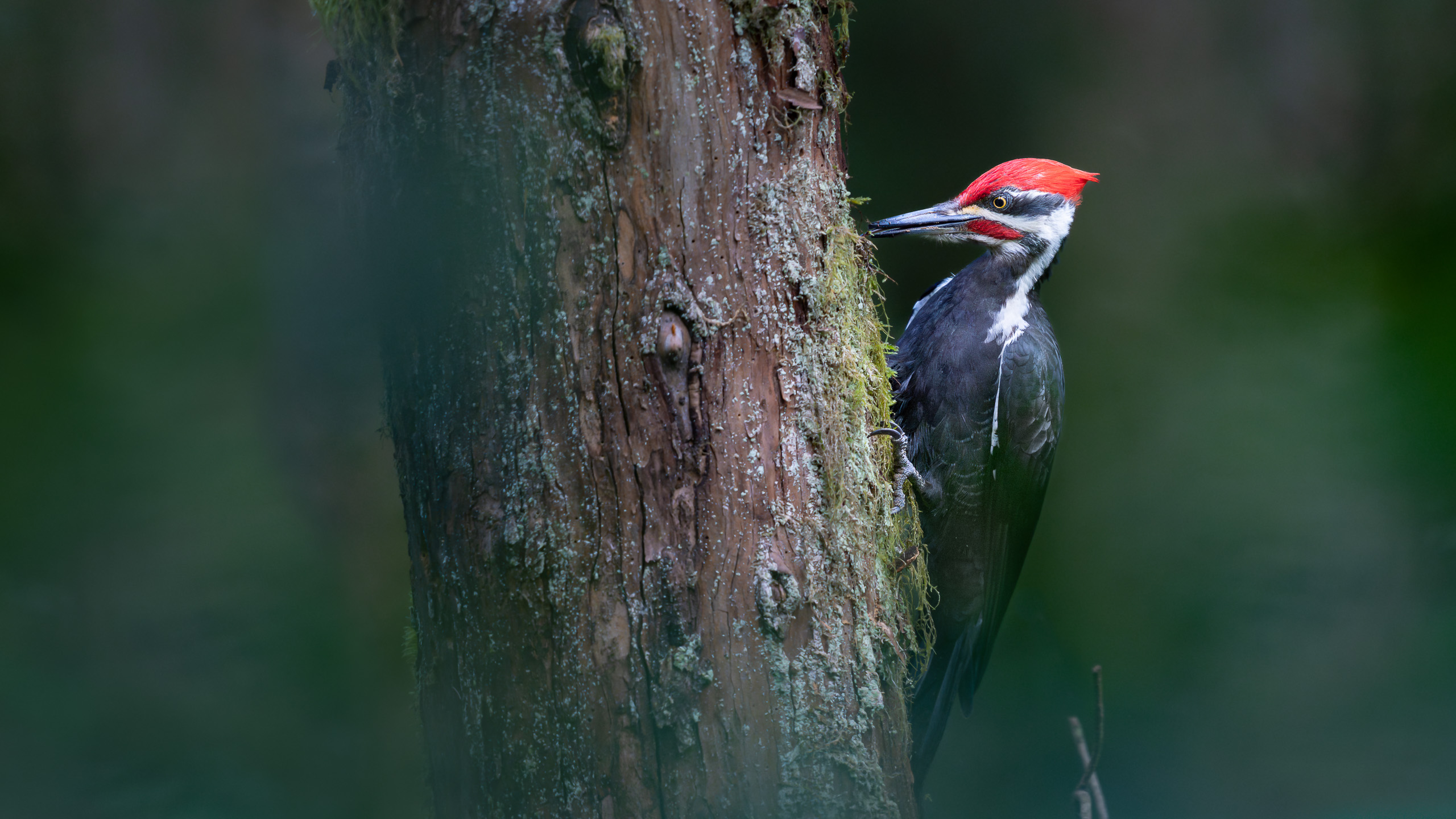
With time to walk back and forth on the trail as this Pileated Woodpecker worked a snag, I chose shooting through foliage. Along with the accompanying dark background, it adds mystery to the shaft of light that illuminated the bird. Visualization — and time in the field — are key. Bridle Trails State Park, Bellevue, WA.
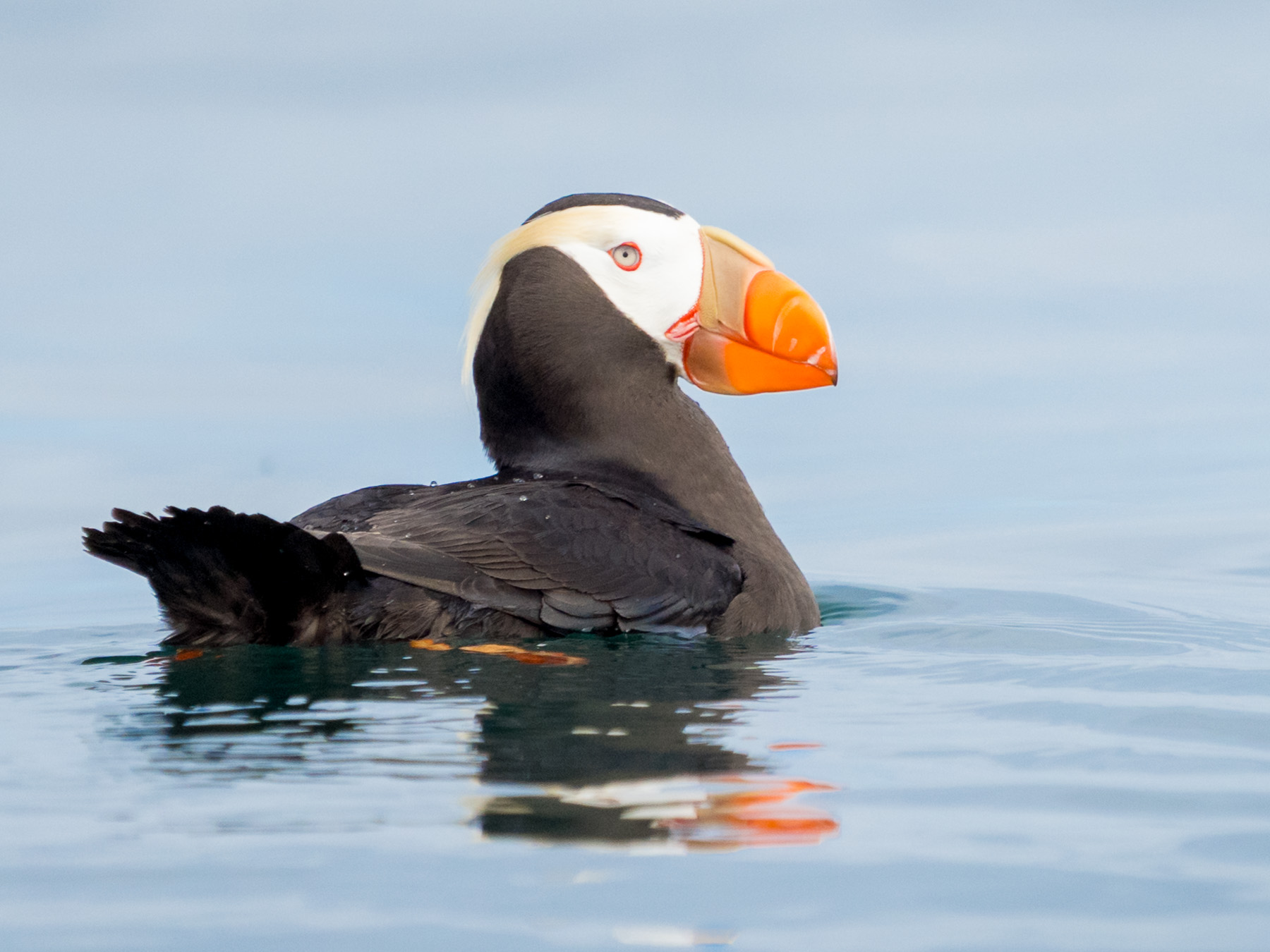
Smith Island, an adventurous, not-so-easy, local Puget Sound paddle, viewed from the north.My evolution toward photographing locally has roots in the pandemic. Covid-19 erupted in March, 2020, at a nursing home a mile from our Kirkland home. I had a quick, social-distancing response: kayak solo. Nice head angle, blue wash background, kayak-low perspective. Smith Island, WA.Already, I was paddling the Sammamish Slough for workouts and bird photography. With the pandemic, the workouts got longer, more frequent and more intense. I cast about for nearby destinations, and hit upon paddling to Smith Island, a location rather far offshore, west of Whidbey Island in the Salish Sea. Significantly, Smith has protected status as a part of the San Juan Islands Wildlife Refuge making it illegal to land. But paddling there also meant Tufted Puffins! I chose to paddle in July, kayaking six hours and sixteen adventurous miles.1 Returning to Whidbey, I felt exhilaration and accomplishment from this half-day trip. I told Kate later it was a best day of an anxious year.
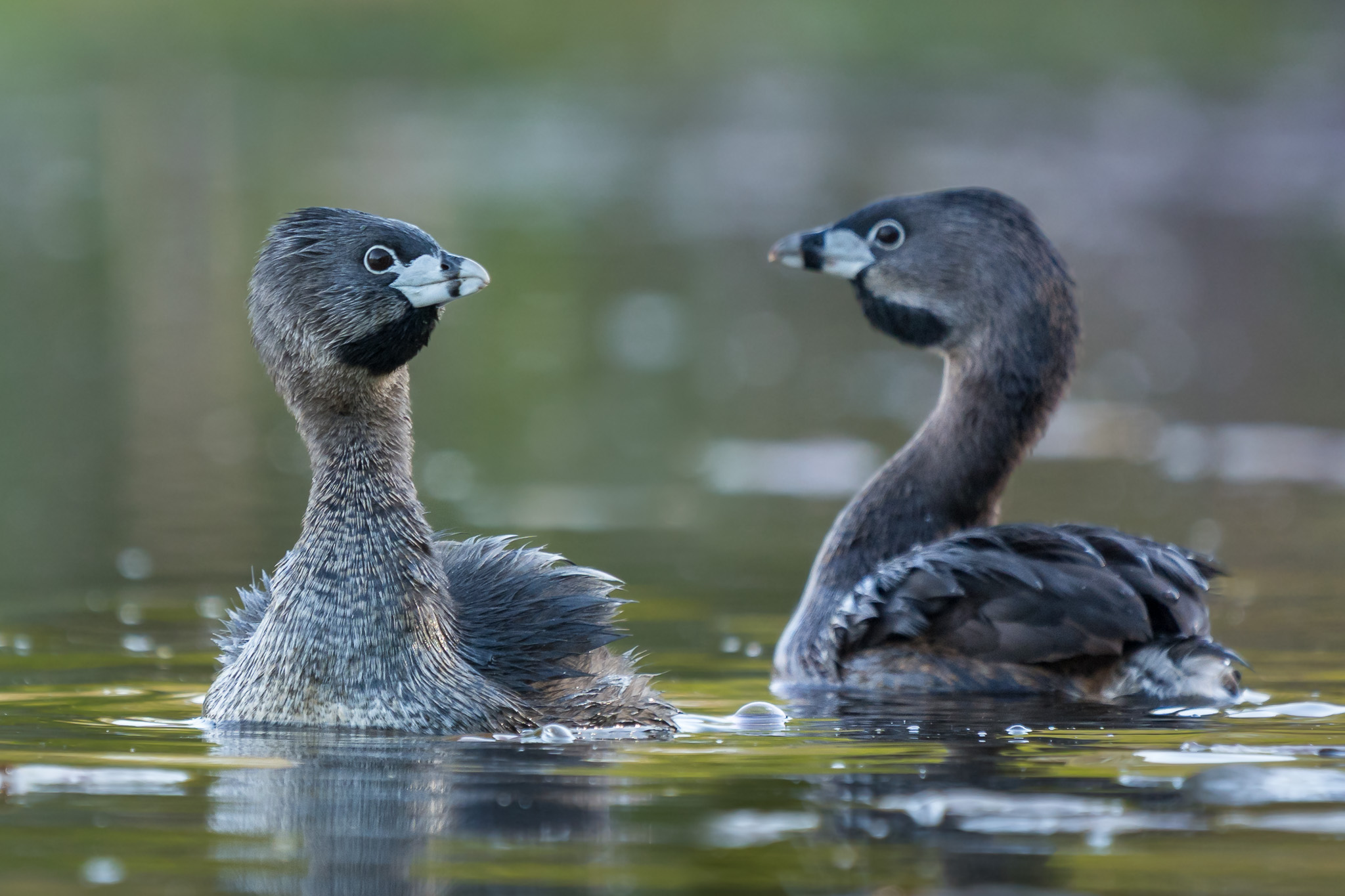
Male Pied-billed Grebe territorial stand-off. Duck Bay, Seattle Arboretum.The following spring, I paddled on Union Bay in Seattle. By May, in and around Duck Bay, I found three Pied-billed Grebe nests. With the pandemic still raging, forty-two kayak trips documenting the grebe nesting successes and failures followed. I took notes. I felt the story that year paralleled Martin J. Muller’s (1995) Grebe study on Green Lake in Seattle.2 Observing and photographing this local bird was, once again, a high-light of my year.3
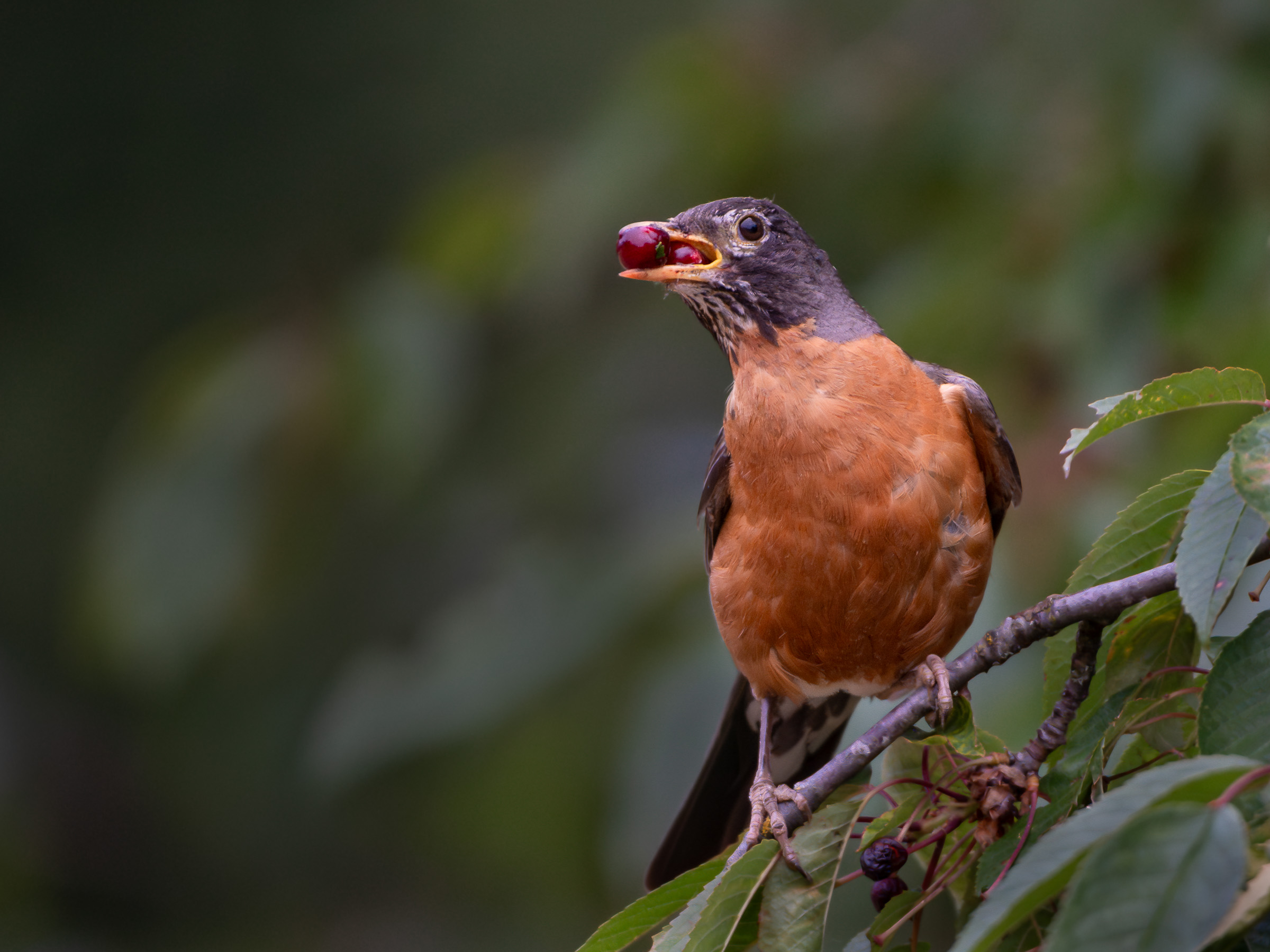
American Robin at Juanita Bay Park, Kirkland, WA.In 2023, I discovered Joan Strassman’s Slow Birding. Instead of chasing birds, compiling bird lists, or as she calls it, “motor birding”, Strassman urges focus and finding joy on birds right where you are, birds in your backyard or local park. Each Slow Birding chapter dives deep into a local species natural history. For instance, did you know our American Robin is the biggest fruit eater after Cedar Waxwings? They don’t just cock their heads and hunt worms. Evolutionary biologist Strassman fascinates with her stories of local flickers, Cooper’s hawks, juncos and even starlings.
Learning about our local birds connects us to the natural world and our local community. Photographing at home means more time in the field, less time travelling, more time to slow down and observe. Learn animal behavior; discover new ways to photograph. The enhanced experience with birds leads to more meaningful pictures. It’s fun. You become a local expert.
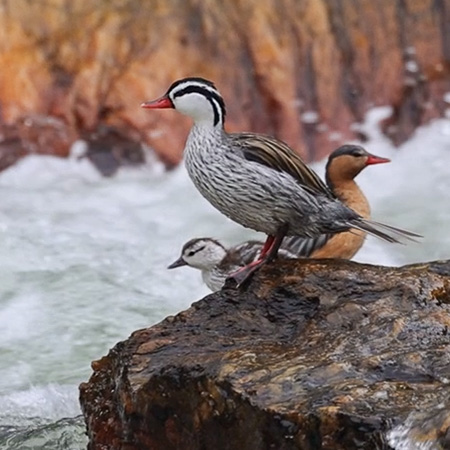
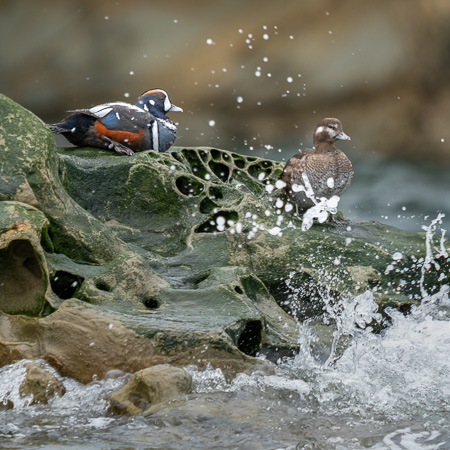
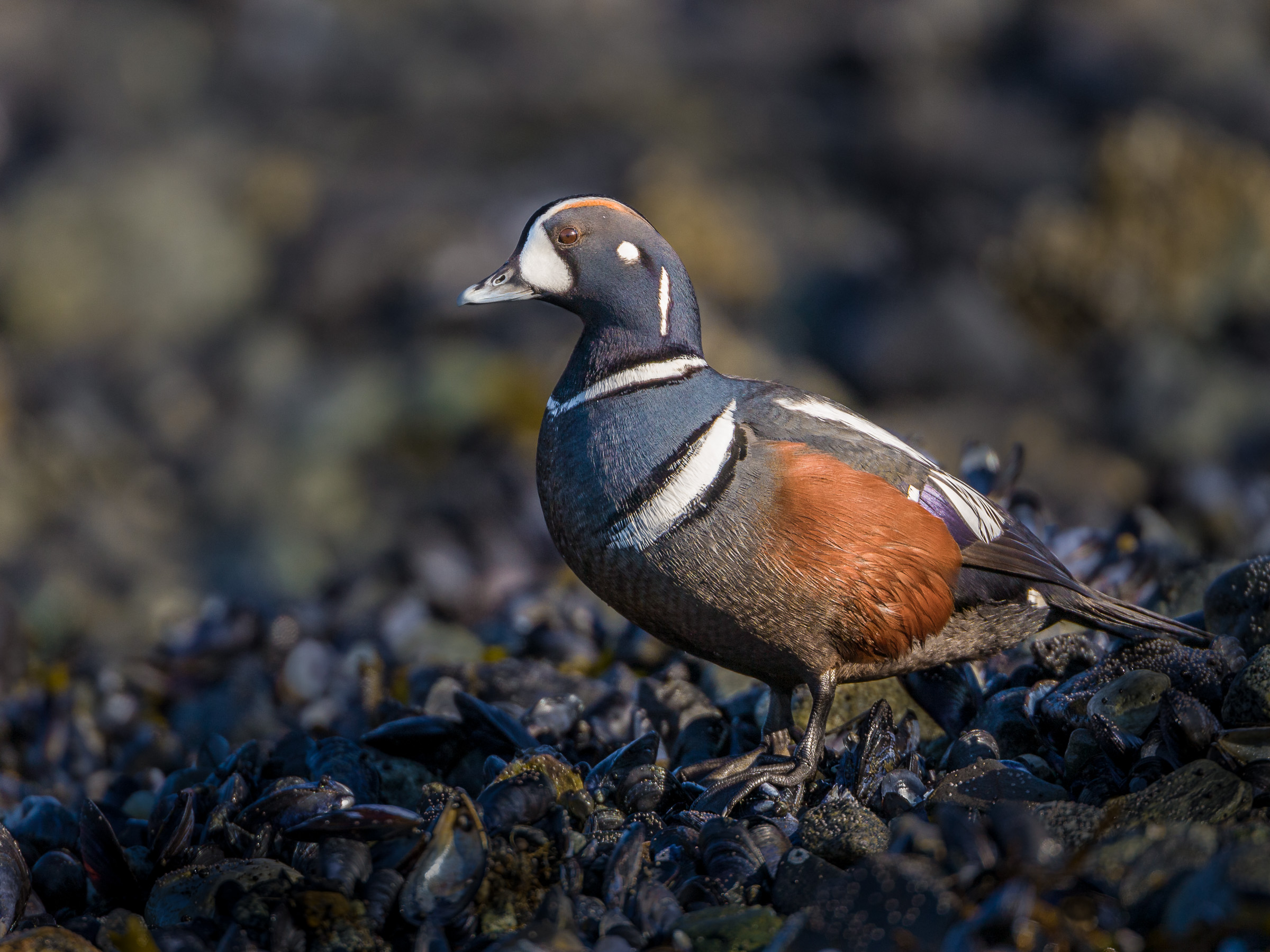
Torrent Duck family, Equadorian AndesHarlequin Duck, Puget SoundGuy Tal said, “There are two ways to obtain a trophy. One is to perform a notable act worthy of reward, and the other is to go to the trophy store.”4 We have a travel industry dedicated to enticing us into jumping on airplanes to go see exotic things. In South America, the Torrent Duck spends its life on rushing streams in the Andes. Evidently, it’s a shiny new thing sought by birders and photographers. Get a guide to take you to the “spot”; get the trophy. Kate received the photo (far left), forwarded from a fellow birder, about “this remarkable South American waterfowl.” When I saw it, I reacted with dismay: “We have our own Torrent Duck! Right here at home!” Our Duck seeks rushing waters to nest, just like the Torrent. But ours nests stream-side in the Olympics and North Cascades. Even better, our Duck winters on salt water at Constellation Park in Seattle. If you haven’t guessed yet, it’s our Harlequin Duck.5 And is the Harlequin a “thing”? No. You don’t have to travel far to see it. You don’t have to hire a guide. You only need to learn specifics about a local bird. Male Harlequin Duck. Candidate for most handsome duck?
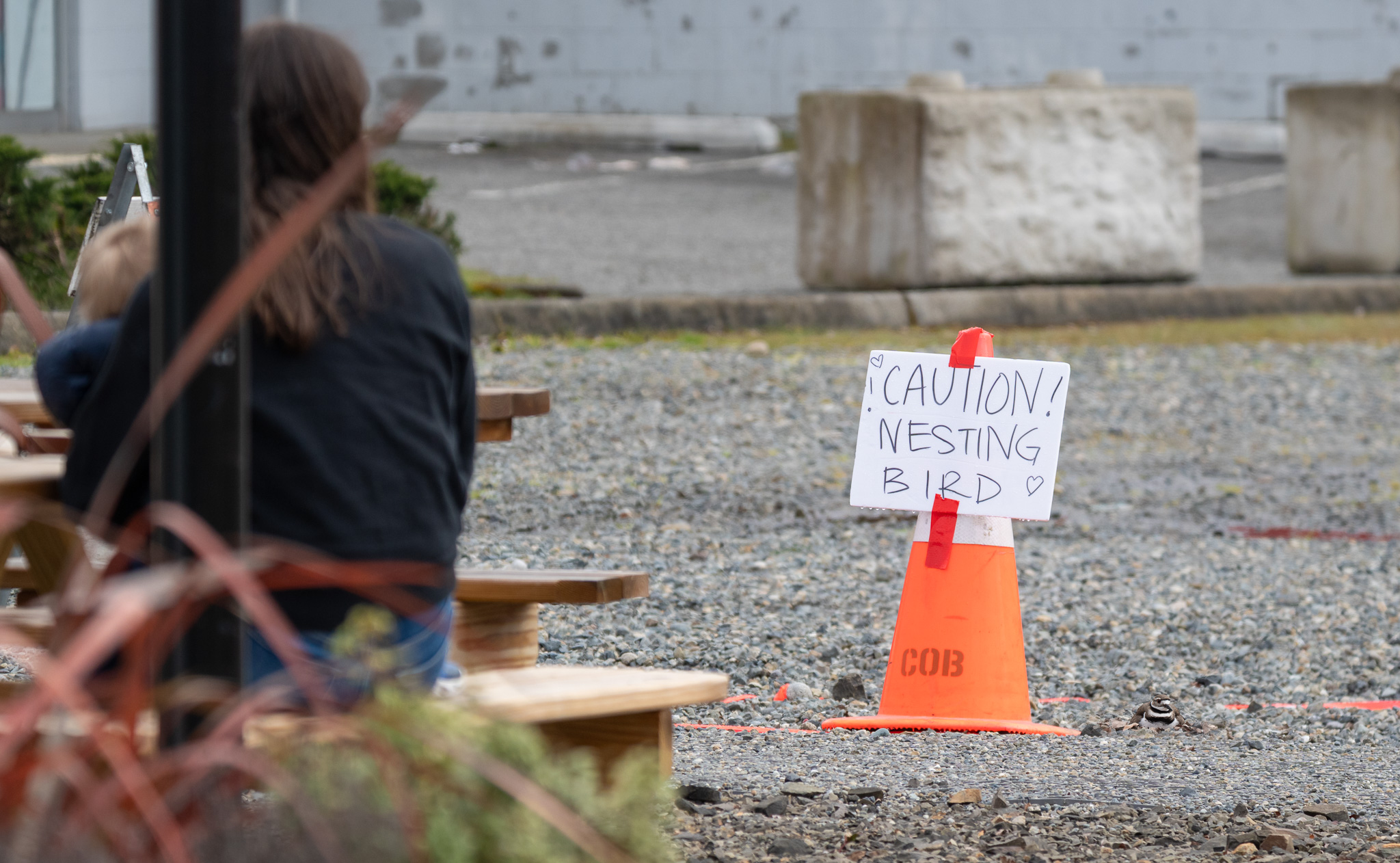
Killdeer nesting in Bothell parking lot.Teaching moments abound with local knowledge. In March, 2026, a killdeer nest appeared in a downtown Bothell gravel parking lot. Lots of foot traffic nearby with the nest 10 ft from the walkway, 15 ft from seating, and 20 ft from the entrance to the Brewtastic Biscuits kiosk that serves doggie treats. After the nest was orange-coned, warning-signed and taped off, walkers-by were variously bewildered, shocked, fascinated, appalled. I talked to a woman with a young child seated at a nearby table. She was bewildered. Why would a bird nest on the ground, let alone in the open with all the foot, dog and even car traffic? I said killdeer like open terrain for nesting; they have big eyes. Once an adult bird steps elsewhere, it’s hard for predators to find the nest. Killdeer scream and feign injury to draw predators away. I hope she left with a new thought about nature. Killdeer in general are winners across North America.
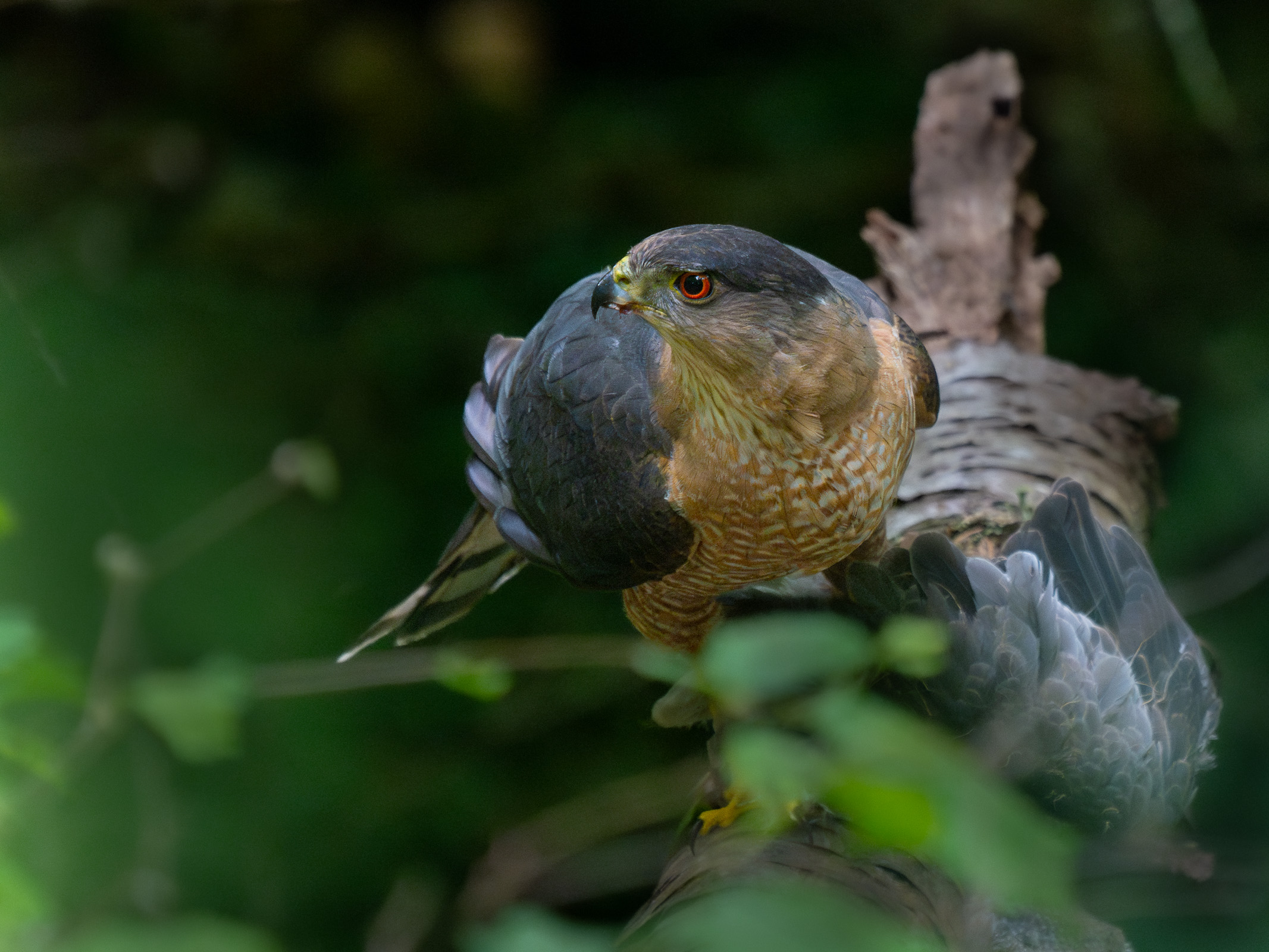
Female Cooper’s Hawk with prey Band-tailed Pigeon. St. Edwards State Park.Another city bird is our Cooper’s Hawk. We’re used to seeing or hearing about Bald Eagles and Peregrine Falcons in the city, but the true city and suburban raptor is the Cooper’s Hawk, the local avian bird hunter that shows up at bird feeders and pea patches. Slow Birding has an engaging in-depth description of the Cooper’s come-back from DDT and its local habits.
If the Coop is our avian predator, the bobcat is its carnivore equivalent. Both rely on stealth and hunt birds, although the bobcat prey is more rodents and rabbits. A bobcat pair calls home the Forbes Creek and Juanita Bay Park area, and perhaps our Juanita neighborhood. A bobcat was in our backyard recently, and our next-door neighbor found one hiding in the front yard shrubbery, perhaps waiting to pounce on a rabbit. Bobcat can leap ten vertical feet, enough to catch a mallard in lift-off. The bobcat is expanding its range into cities, including a northward expansion that is displacing the Canadian lynx due to a global warming.
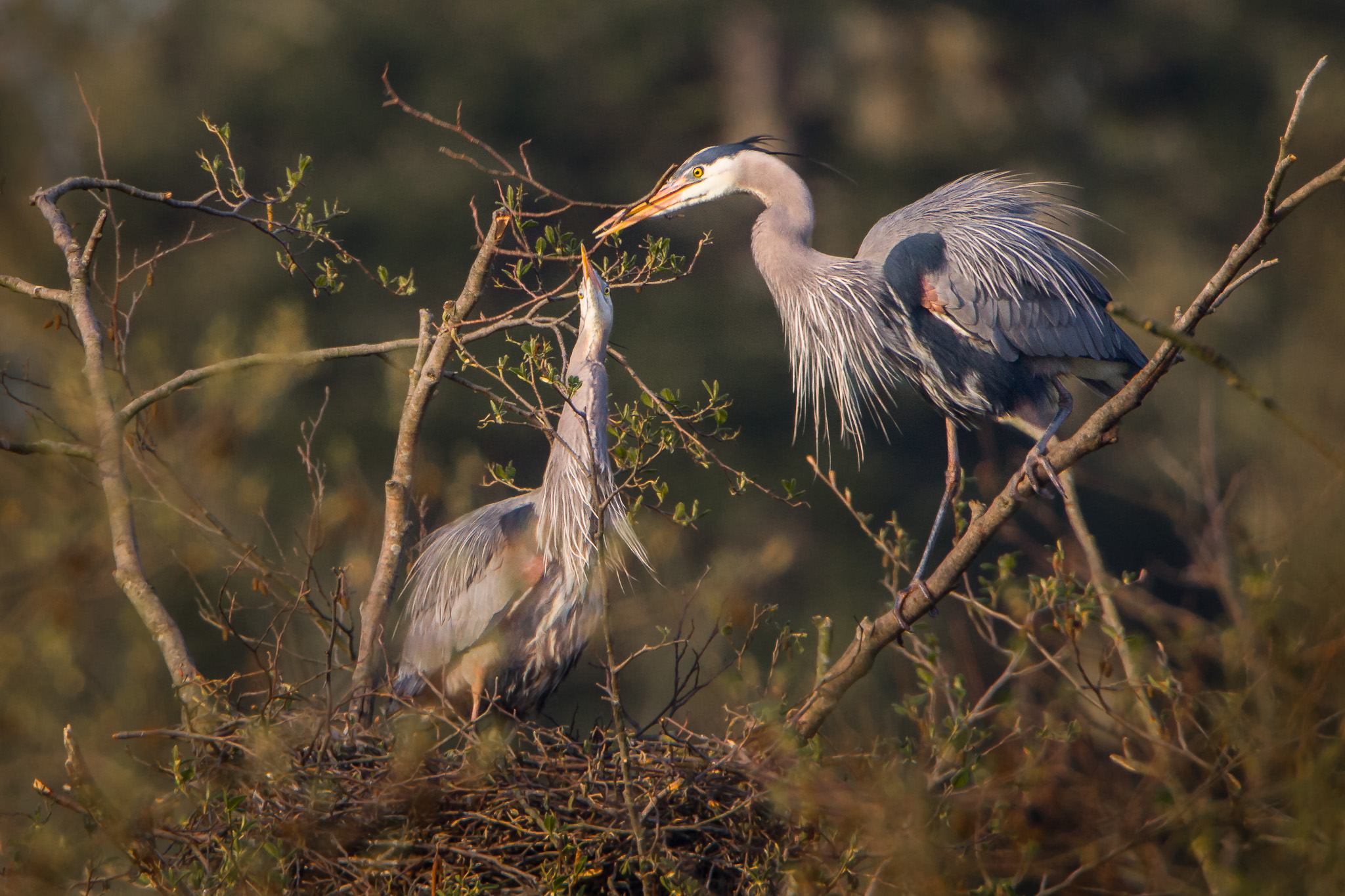
Male Great Blue Heron presents female with stick for nest, Yarrow Bay, Kirkland, WA.I’m fortunate to kayak. It’s human-powered, and a bird photography niche with endless waterways and shoreline terrain for exploration and photography. Many bird species winter on area fresh and salt water. Years of paddling have acquainted me with the time and place to find birds by kayak, birds like our year-round herons, winter-fishing mergansers, or summer osprey that plummet from the sky to catch fish. In past years, I’ve always captured more bird images by kayak then on foot.
Another concern pushes me toward photographing home. We have new challenges in a warming world. The big threat is fossil fuels, America’s kryptonite. Worldwide, a few countries are making progress —look at Denmark, Chile, Morrocco, the UK. The USA is not, ranking along with Russia and Saudia Arabia for poor climate policy and high emissions per capita.6 But getting off fossil fuels means more than just climate: it’s a national security issue. The USA is a very brittle power destined for failure without correction. Across nations, solar is the cheapest energy source and the quickest to deploy, including in much of the USA. And only solar can be deployed both residentially and at utility scale. Countries that don’t transition will suffer competitive disadvantage.7 Renewables create local jobs and stimulate the economy.
Solar plus batteries and wind are the pathway to a livable future. Buildings and transportation can easily run on electricity. Many industrial processes can be powered with renewables. Fossil fuels should be seen as a resource for tough-to-replicate needs, issues like long-range air travel or hard-to-substitute plastics and medicines.
Did you know switching to electricity will halve our energy needs?8 Our own home is an example, see All-Electric Home One Year In.
Photographing locally is a rewarding adaption to global warming, the most grave threat to the planet we call home. The planet we want depends on the choices we make.
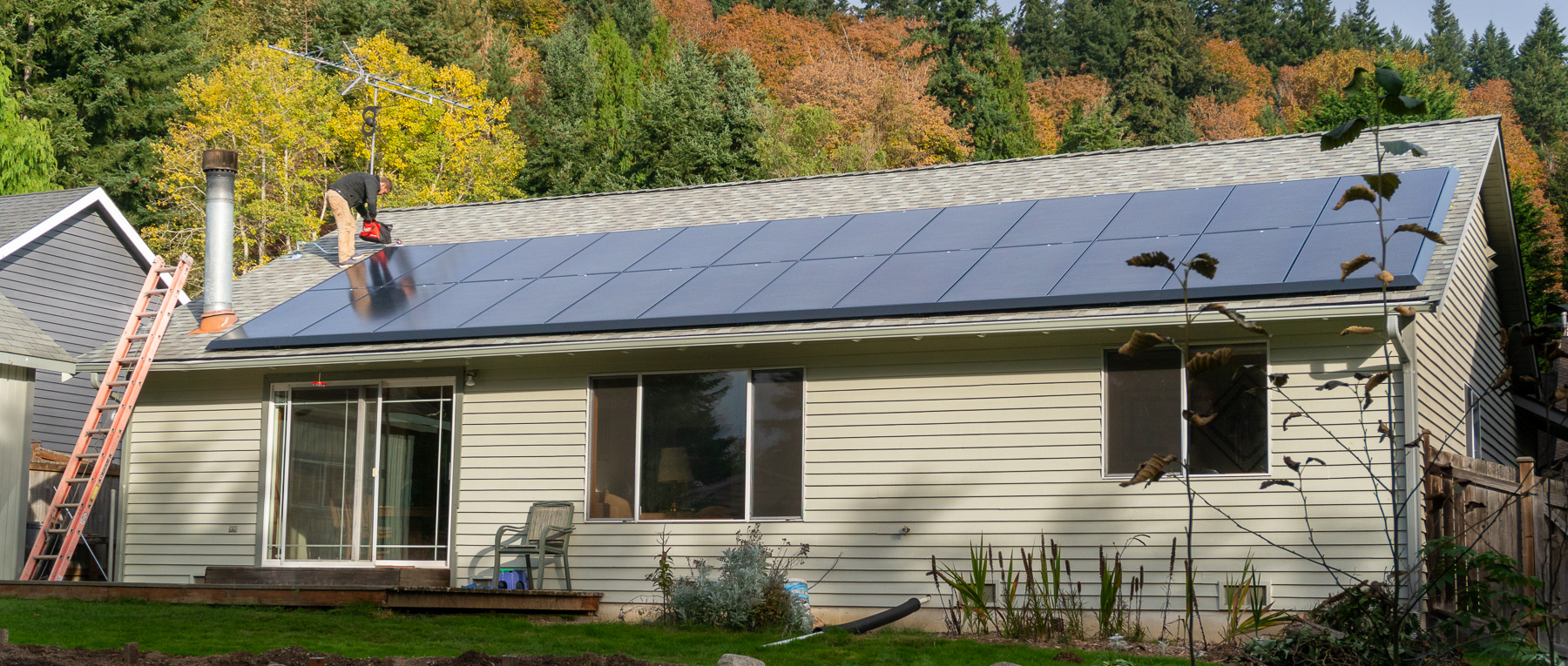
24 solar panels installed in 2020. Room for 12 more.Gary is volunteering for Energy Smart Eastside, with communities of Bellevue, Kirkland, Redmond, Mercer Island, Sammamish and Issaquah participating. Its primary purpose is a campaign to replace gas and oil furnaces with heat pumps. Incentives are paid through the Washington State climate law. If you’re still heating with fossil fuels, check us out, and make your next choice a heat pump.
Footnotes:
1Read a full account of the Smith trip here. I might add, standing alone on the beach in the early morning before launch, that distant view of flat-topped Smith Island looking so, so far away, it simultaneously evoked anticipation, excitement and a bit of fear.
2See WOS publication Washington Birds 4, p. 35-59. December 1995. “Pied-billed Grebe Nesting on Green Lake”, Seattle, Washington. Martin J. Muller. Enlightening documentation of Pied-billed Grebe nesting.
3My intent at the time was to publish a full account of the grebe year at Duck Bay. I lacked some specific behavior photos, though, and my video from a kayak was shaky. The project remains incomplete.
4Guy Tal. More Than A Rock, Santa Barbara: Rocky Nook Inc., 2015. p. 84.
5I love the Harlequin Duck scientific name: Histrionicus histrionicus. The name derives from Latin meaning “pertaining to acting”. The male HARD’s striking plumage somewhat resembles the Harlequin character’s checkered costume.
Jesus Christ, Gary. Sometimes it’s shocking.
I can’t believe I actually know the photographer who created those images. What can I say. They stir memories and calming feelings in me.
Thanks Les. Warms my heart. And then there was the time you grabbed for your video camera when that sow bear with the enormous cubs was approaching our camp on Kodiak! 🙂
Gary, your photos are just stunning. Up-lifting. “Works of art” doesn’t do them justice. Thanks for sharing not only the birds but also the electric house experiences.
Nancy, thanks so much. And thanks for mentioning the electric house. This morning, a film crew from the city of Bellevue is coming over to interview me as part of a promotion for heat pumps and electrification.

As always, wonderful images with insightful and interesting commentary. Thank you, SAM
Thanks Sam. Good to hear from you. It’s been fun exploring locally again this year. Gary
Jesus Christ, Gary. Sometimes it’s shocking.
I can’t believe I actually know the photographer who created those images. What can I say. They stir memories and calming feelings in me.
Thanks Les. Warms my heart. And then there was the time you grabbed for your video camera when that sow bear with the enormous cubs was approaching our camp on Kodiak! 🙂
Nice shots as usual, Gary !!!
Jay, thanks so much! Hope you’re getting out photographing.
Gary, your photos are just stunning. Up-lifting. “Works of art” doesn’t do them justice. Thanks for sharing not only the birds but also the electric house experiences.
Nancy, thanks so much. And thanks for mentioning the electric house. This morning, a film crew from the city of Bellevue is coming over to interview me as part of a promotion for heat pumps and electrification.