“Photographers seeking the ‘good light’, going where everybody goes, aiming for an ideal, miss everything else.” — Erin Babnik1
Shooting and processing panoramas was difficult in the early- and mid-00’s.2 Hardware tools were few. A process tool was introduced by Adobe in 2001, but merge failure was frequent, and computer power was a stumbling block. Manual assembly was hard as well, but the promise was there. In 2008, Microsoft made available (for free) Image Composite Editor (ICE). Although it required leaving Lightroom,3 I ran many sets of images thru ICE, and it consistently merged panoramas where Adobe failed. By 2015, Adobe Lightroom and Photoshop Photo Merge had introduced HDR-panorama; for me it was panorama nirvana from heaven. It rarely failed and—with HDR—there was less reason to leave Lightroom for Photoshop. Improvements in general meant even hand-held panos processed smoothly if care was taken in the making. That said, panoramas with close foregrounds need a tripod and a physical means to rotate the lens about its optical center.4 Doing so reduces parallax, the root cause of errors or process fail.
Opportunities for panoramas are boundless. Seeing potential—going beyond the “good light”—takes thought, practice and especially time in the field.
Case in Point: Point of the Arches
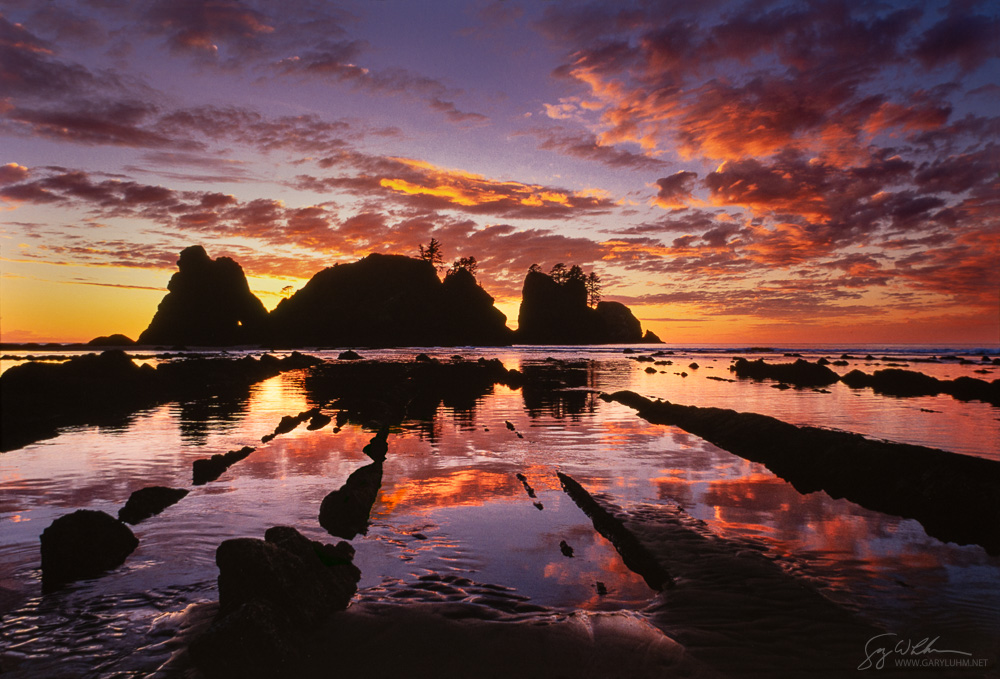
Canon 10S, 24mm lens, Velvia film.Point of the Arches in Olympic National Park became an obsession of mine soon after outdoor photography overtook competing interests. The image at left—from the late 90’s—captured a particular dream after numerous failures. A Labor Day ritual back then was paddling sea kayaks to Shi-Shi Beach and camping close to the Point. On this weekend, I postponed dinner after noting offshore clouds. The tide, partway out, exposed well the folded, sedimentary rock. The sun lingered—no offshore fog. I quickly found the spot to plant the tripod. The “shot” was pure old school: A single exposure on Velvia 50 film, 2-stop split ND filter, mirror-lock, 2-sec time delay on a with a 24mm TS-E (tilt/shift) lens. This was the vision that drove me (and many others) to the Point.
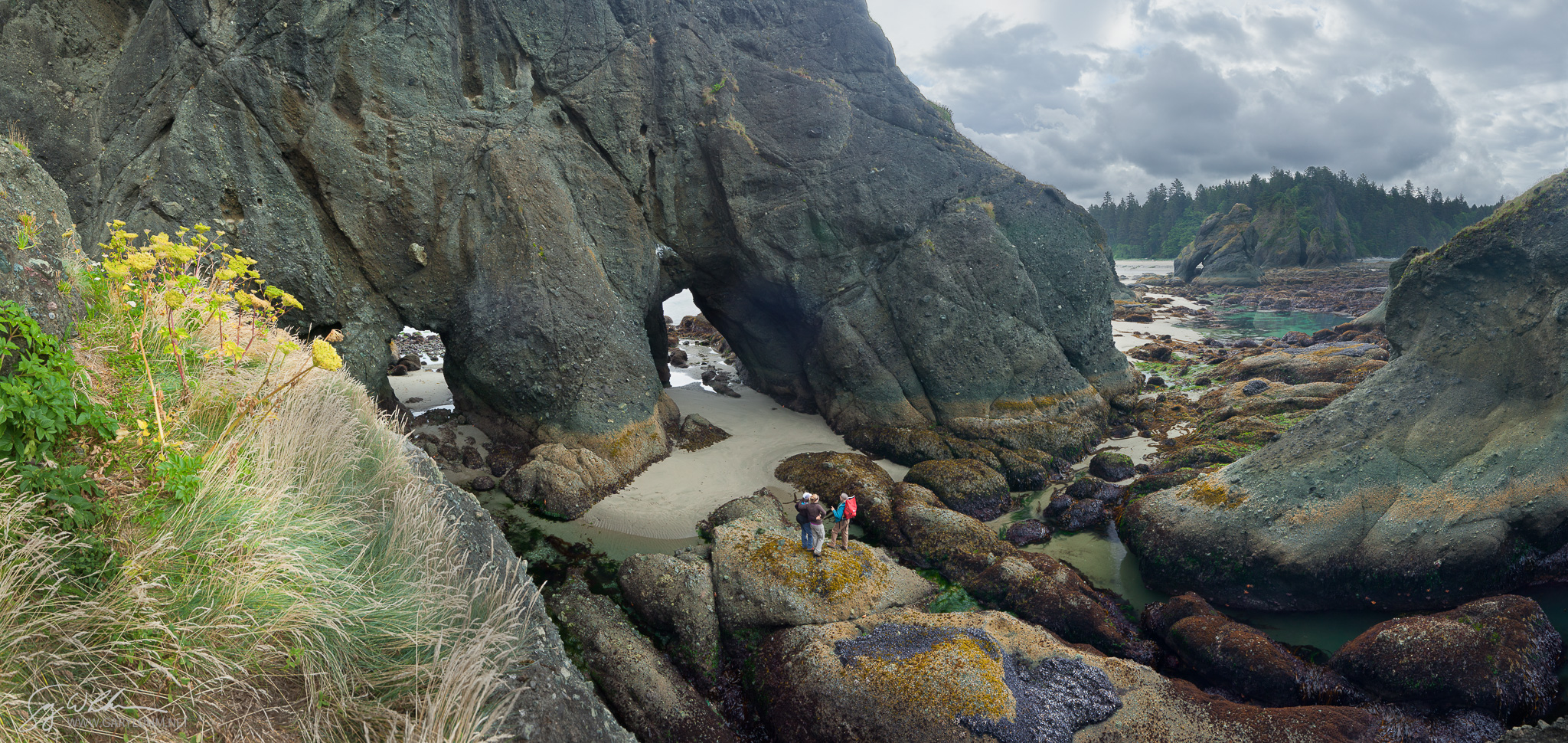
I belatedly realized on subsequent visits, the sea stacks at Point of the Arches offer so much more. The tide pooling is phenomenal, wildlife abounds and there are many mesmerizing scenic views. When computing power evolved and made panoramas practical, the panoply of sea stacks compels a seeing eye. Canon 5D II, 25mm, ISO 100, 1/5s, 1s, f11.In August, 2011, I kayaked in for a three-night stay. A panorama that jumped out for processing was this one (above), shot after I walked up the side of a sea stack. I love the subtle diagonals, the repeat archways, the peek-a-boo look toward the distant shore. When three women paused on a rock as I set-up, I included them. They add color, scale and interest. I thought this shot would be the best of the shoot. But on the other side of those archways two hours earlier—well ahead of the minus tide minimum—I shot a set I had never-processed.
Canon 5D II, 24mm, ISO 100, 1/60s, 1/200s, f11.The discovery and processing happened in October, 2025. Lightroom assembled it from selected exposure pairs to create a seamless HDR-Pano. After some dogging and burning, I took it into Photoshop and used Puppet-Warp to straighten the horizon. The straightening made my day. Puppet-Warp was introduced in CS5 in 2010; I had never used it (duh!). But back about the image—there is so much story. It feels to me like I’m hanging out on a precarious edge of planet earth, on a privileged perch, visually drinking in our ancient, seductive home. And I had ignored it. Best seen bigger. Right click and chose “Open image in new tab” for a larger view.
Canon 5D II, 90mm, ISO 400, 1/200s, f16.
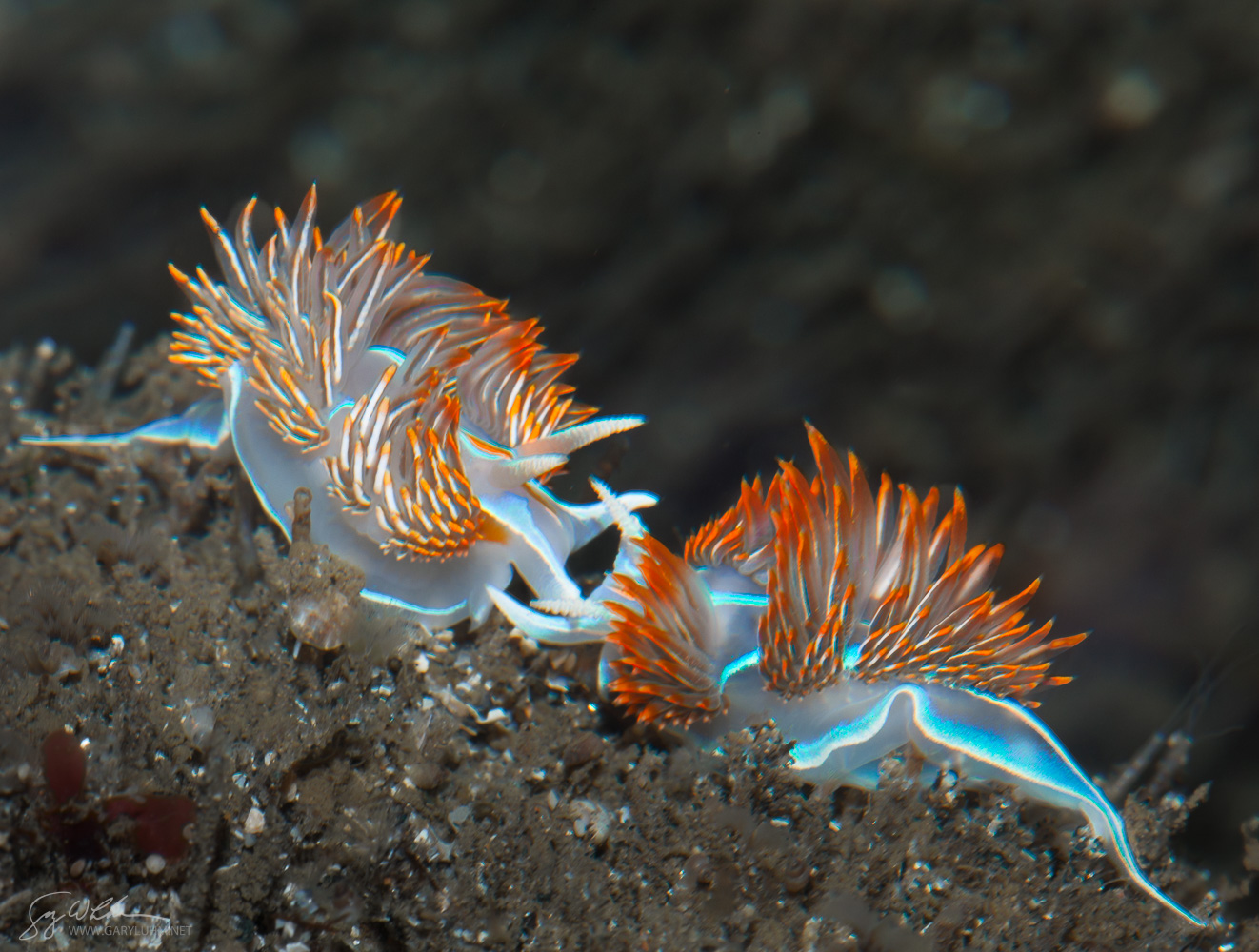
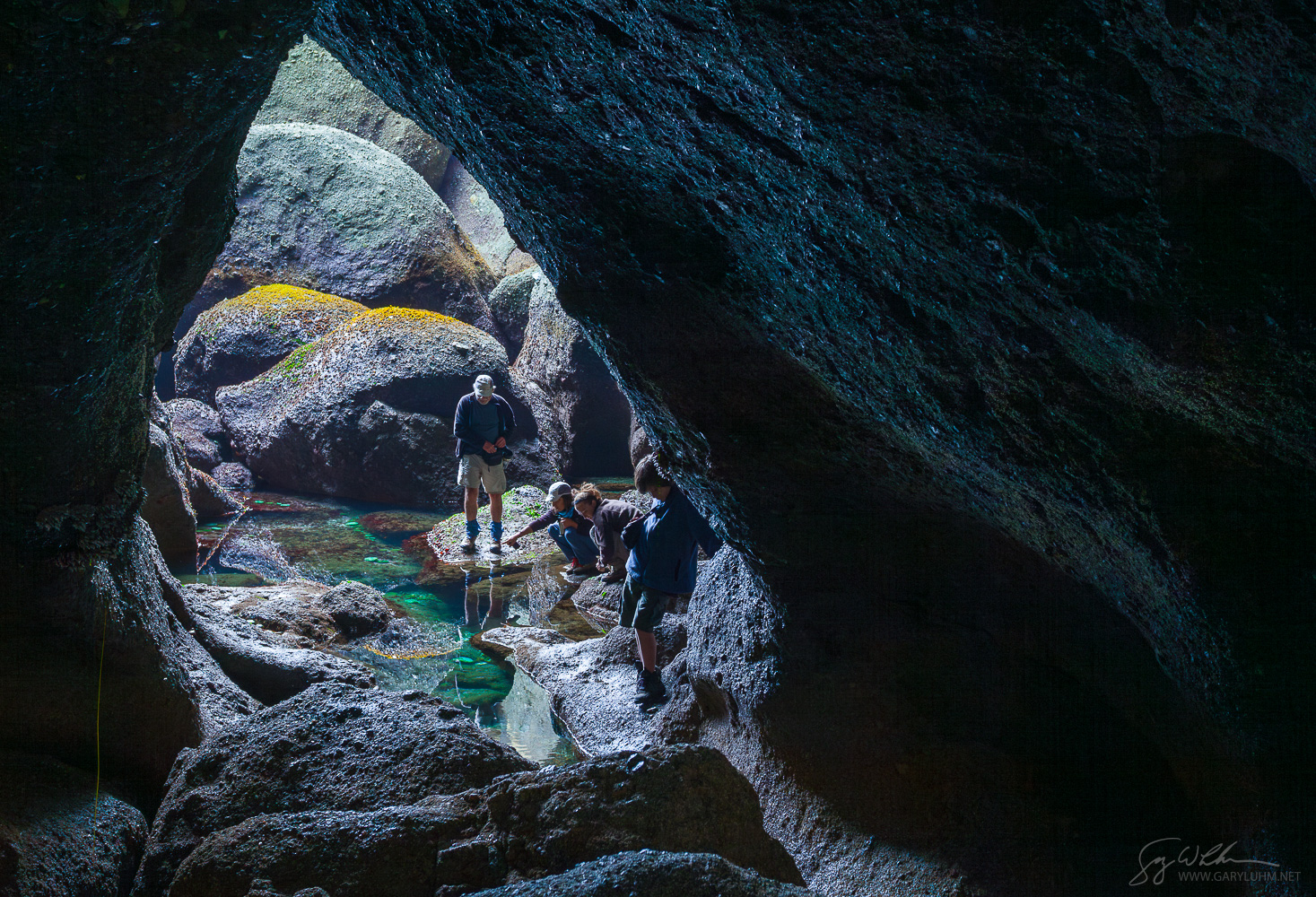
Canon 5D II, 34mm, ISO 800, 1/25s, f7.1.As the tide dropped that morning, I also I scored a planned shot of one of our impressive nudibranchs, Hermissenda Crassicornis. Getting two in a shot was a win. I used an external flash in the dim light. After a family out tide pooling joined in the cavern, I captured them inspecting an interior pool.
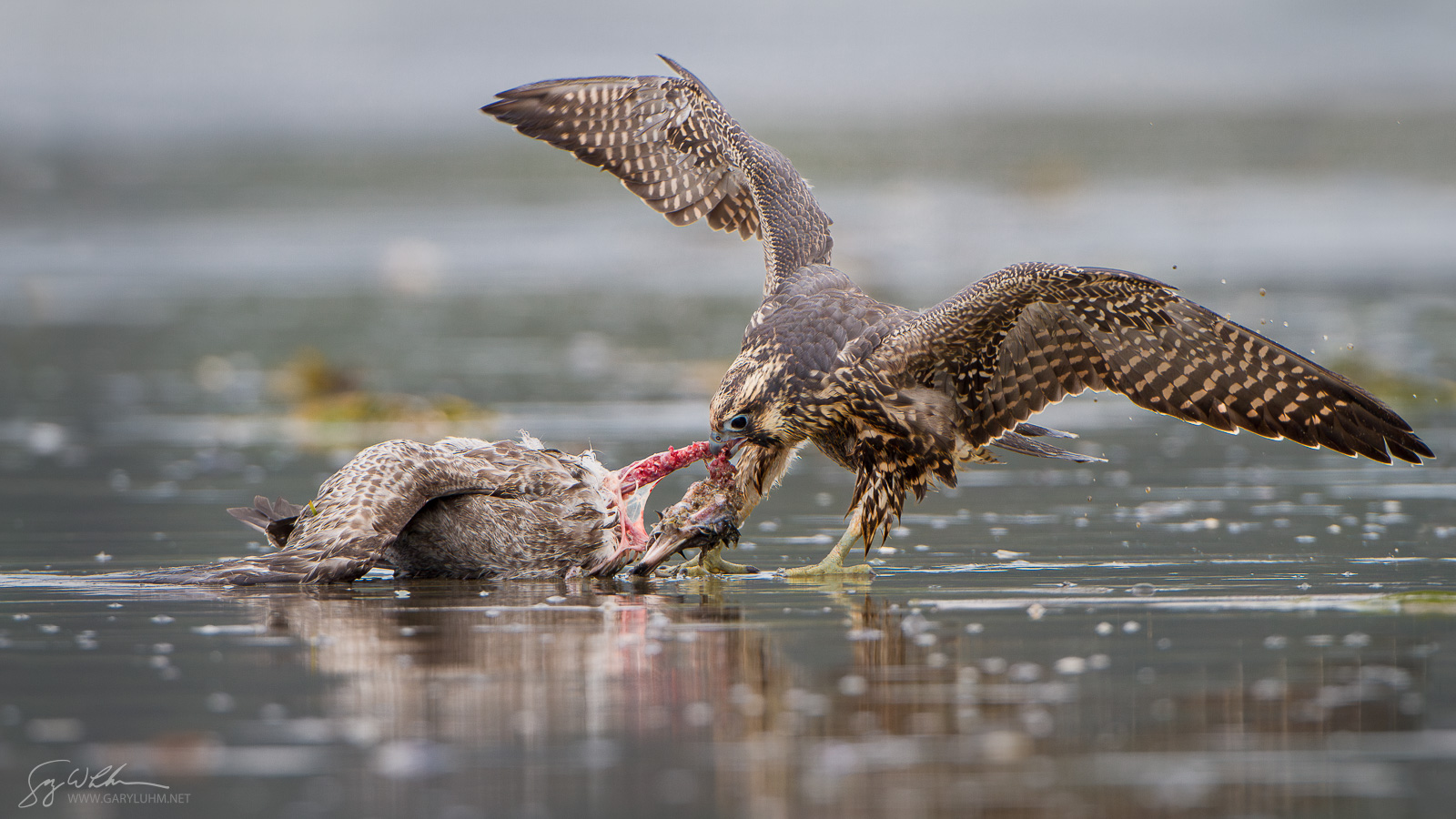
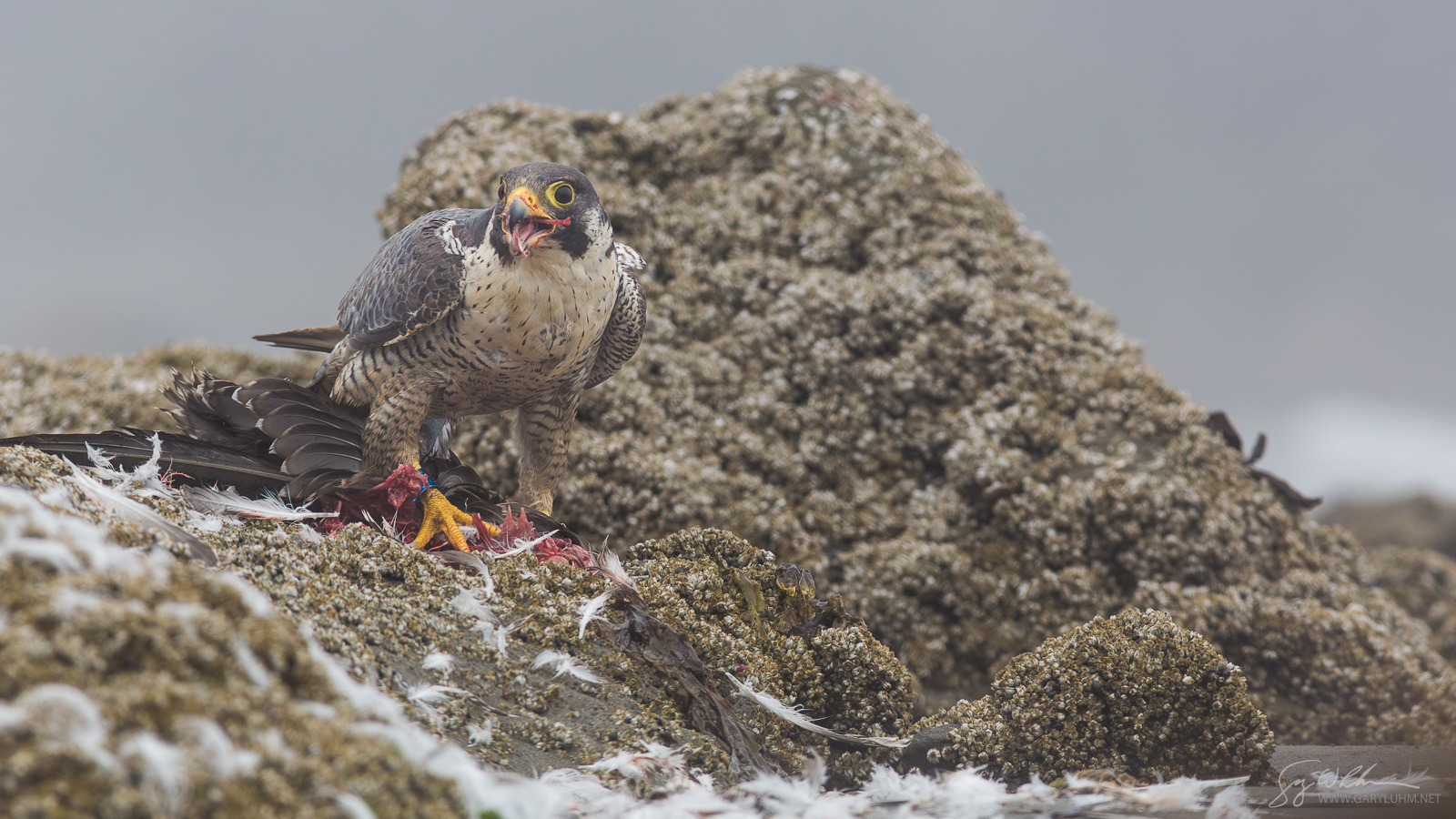
Canon 7D, 500mm f4, ISO 400, 1/1000s, f5.6I’d be remiss if I didn’t mention wildlife. I was aware from prior visits that Bald Eagle, Peregrine Falcon and Raven nested here, not far apart on the cliffs and sea stacks. This trip my timing was perfect, as there were two just-fledged juvenile Peregrines about. One evening, they perched in the trees above my campsite! That same day an adult killed an immature Glaucus-winged Gull, and, because I had packed my 500mm f4 lens, I was able to easily capture the dominant juvy tearing into it on the beach. An incoming tide added to the action.
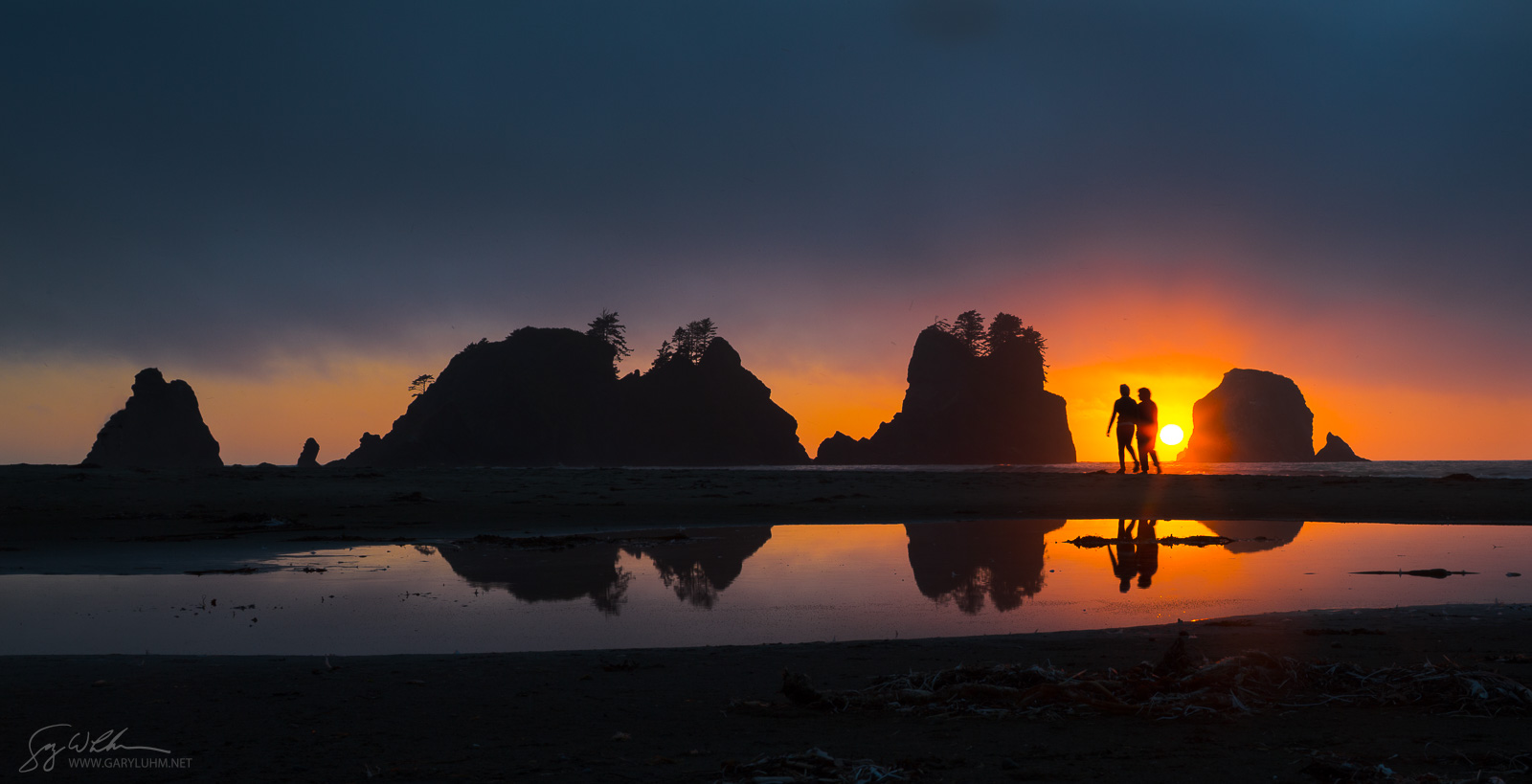
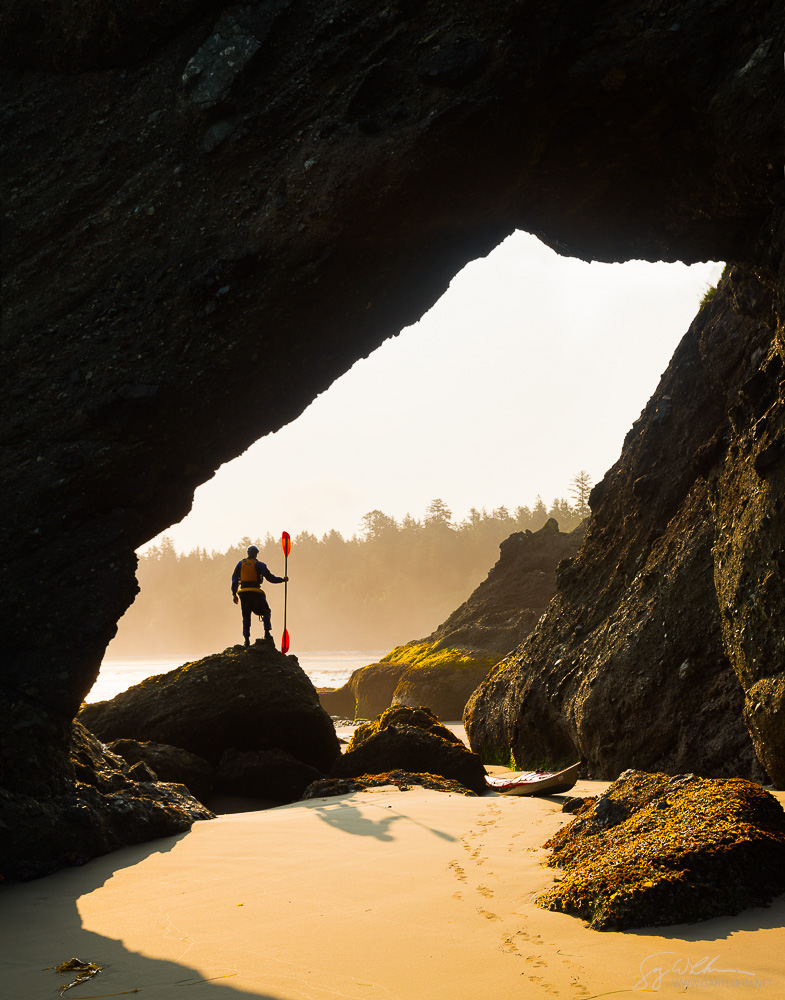
Canon 5D III, 40mm, ISO 50, 1/13s, f16.A downside of concentrating on panoramas is an absence of “decisive moment”. Above I was set up for a single-image scenic, and then an engaging-looking couple walked by. Cropping top and bottom improved the image and achieved a panorama feel. Had I been shooting multi-image pans, I probably would have missed it.
Canon 5D III, 45mm, ISO 100, 1/100s, f8.Canon 5D III, 24mm, ISO 100, 1/4s, 1/50s, f16, focus stack, HDR.In 2012, I visited Shi-Shi twice. In July, solo paddling in for two nights, I tried and failed to re-capture the highs I gleaned from 2011. I did get some tide pool and kayaking pics. The kayak pics never sold.
Canon 5D III, 300mm, 1.4x, ISO 800, 1/1000s, f11Then in August, I joined a Washington Kayak Club trip paddling the Olympic Coast from La Push to Makah Bay. Our last camp, we pulled ashore in fog at Point of the Arches. As we were schlepping gear up the beach, I discovered a Peregrine Falcon on a kill. I dropped everything, grabbed camera, lay down on the beach and captured the moment.
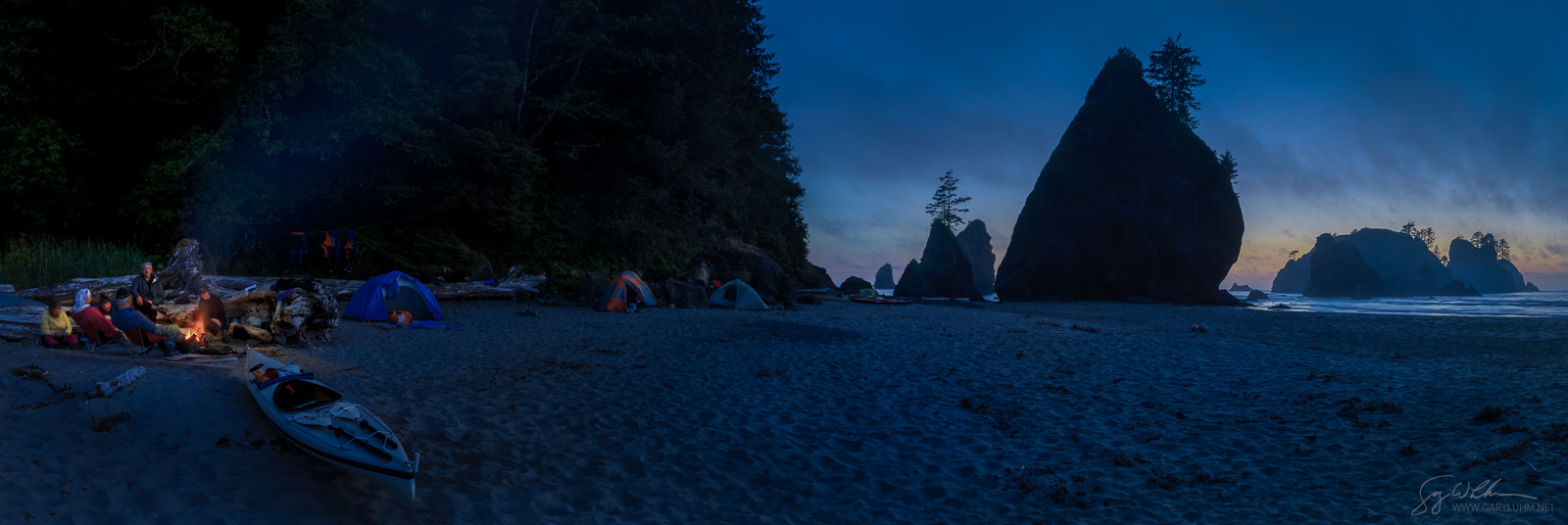
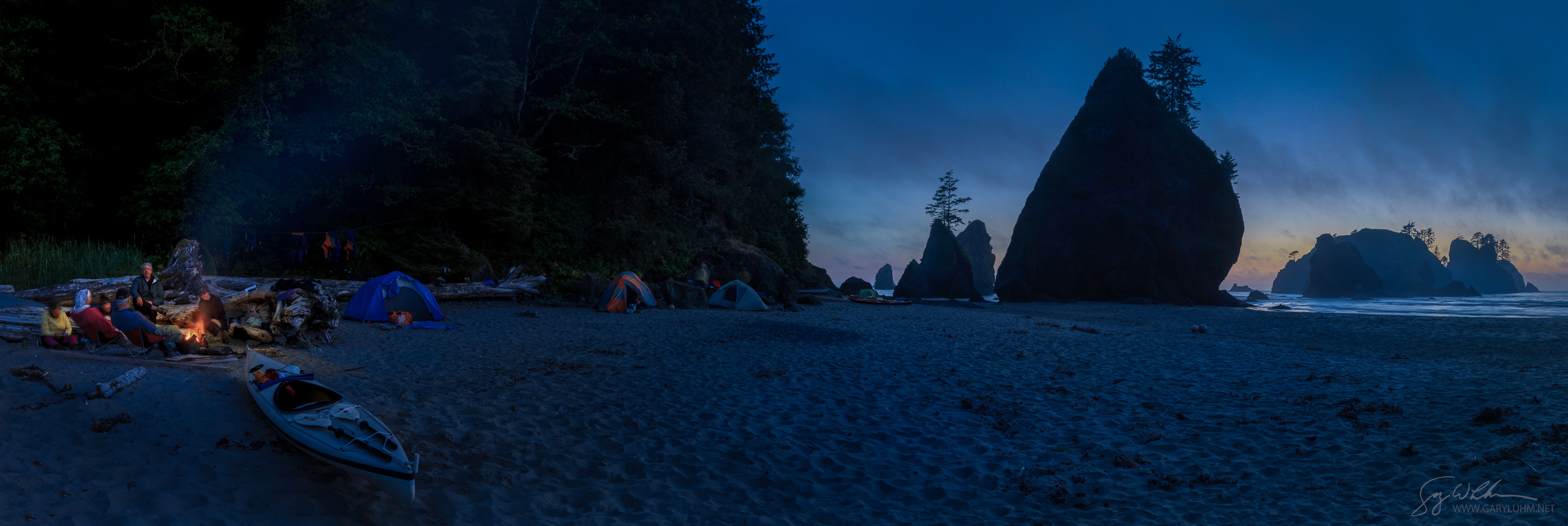
Canon 5D III, 45mm, ISO 400, 2s, 10s, f11.That evening, we gathered at a beach campfire.5 I moved a kayak in position, and did a vertical pan that was under-exposed and, once again, didn’t think it worth compositing until re-discovery this October. In processing, I cooled the scene except for the fire light. Such great memories. The panorama captures—in a single sweep—why we kayak: adventure, scenery, tribe. Once again best seen bigger. Right click and chose “Open image in new tab” for a larger view, on black.
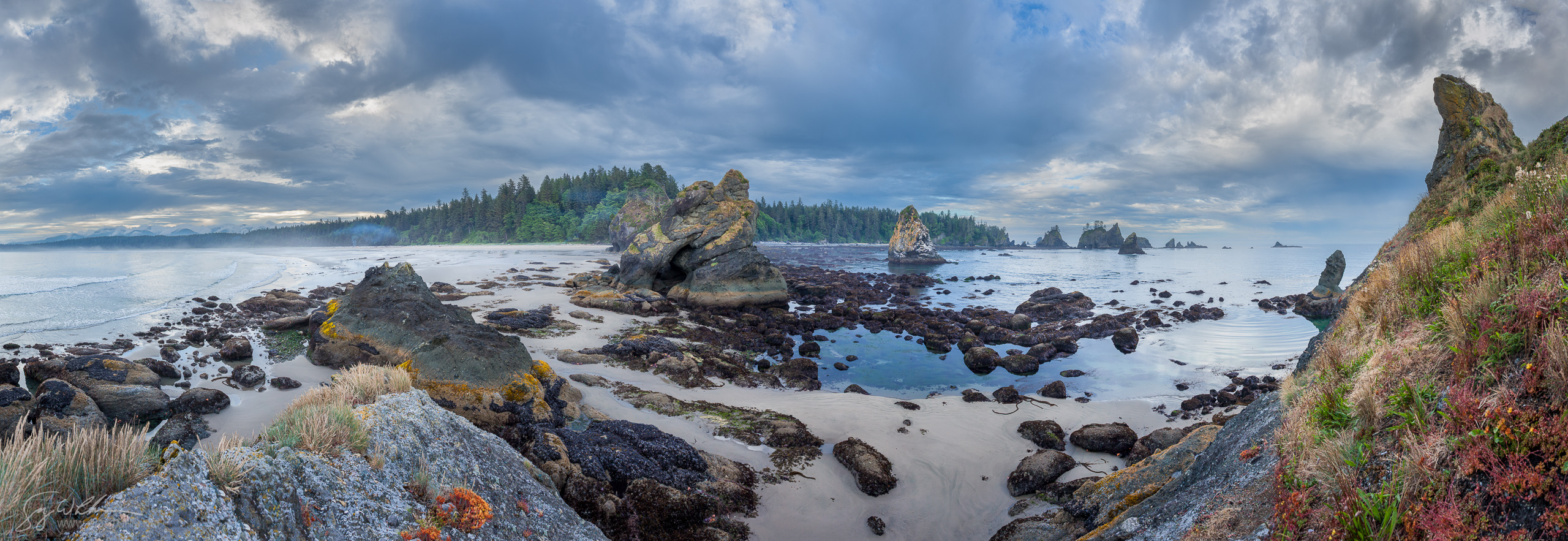
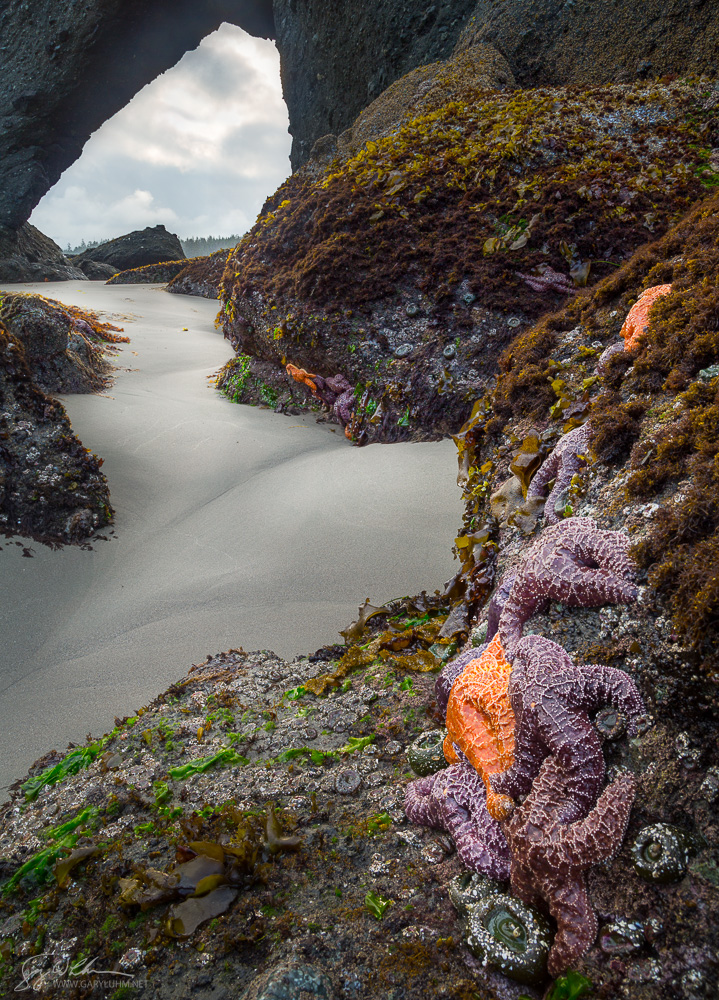
Sony A6700, 25mm, .5s, 2s, f8, ISO 100Lastly, in 2024, I backpacked in with friend Rich, two nights, again camping at the Point. The second morning was overcast, dull light; I call it “get rid of the sky” light. Overcast light can serve like lighting in a studio, just don’t include the light source. When I found this intertidal rock full of sea stars, I felt a panorama might work. I like the context here with the stars flanked left by a sea stack cave opening and flanked right by the ocean. The image made made my “2024 favorites”.
If you go, bear in mind a “good light” sunset isn’t likely. Go to “see”. Schedule a visit during moderate low evening tides and especially early morning minus tides. A receding, summer morning minus tide reveals perhaps the finest tide pooling aside the finest sea stacks on the coast.
Comments appreciated. If you have a favorite here, let me know,
Thanks for looking,
Gary
Footnotes: 1I attended Erin Babnik’s talk titled “Beyond Perfection” at Kenmore Camera’s 2025 November Expo. Babnik introduced herself as an art history scholar, who, as an undergrad learned what she called the “good lie” (i.e. conventional) critique of art. Then as a grad student she learned to be critical of that critique. She then argued for us landscape artists to go “beyond” the “good light”.
2A quality panorama choice in the ‘90’s and early ‘00’s was medium-format film, like the Fuji G617 camera that shot in a panoramic 6:17 ratio. Digital methods quickly surpassed it.
3I purchased Adobe Lightroom shortly after it came out in 2007. I was thrilled then to finally have a decent digital catalogue and editor all in one. For finishing that required layers, I resorted to Adobe Photoshop Elements until about 2017, when I switched to Adobe Photoshop CC and Lightroom Classic. I prefer to edit and back-up on my computer (and back-up hard drives). I do not use the cloud.
4There are numerous hardware tools to ensure success with panoramas that include close foregrounds. For single row verticals, I made a wood tool that works perfectly and is an easy carry while backpacking.
5In recent years campfires in coastal Olympic National Park have been banned much of the summer and in general are restricted to intertidal areas and away from logs. Check the status when you pick up your permit.
8 thoughts on “Getting the shot: Panoramas at Point of the Arches 2025_11”
Beautiful, Gary.
Great collection of shots. Wonderful composition…
Thanks, Dan! Composition is key.
Wow, amazing…first read this on my phone, now so much better on my desktop. Not that there was much room for improvement!
Clarke
Thanks so much. You’re right about the desktop. I didn’t check my phone to see how it looks, but I lay the post out on a desktop and bigger is better.
Gary
Wow !!
Really nice! It took me a while to figure out the pano with what looks like 2 beaches. Because they ARE 2 beaches. Great perspective. I’ve never been there when the tide was that low, but I know the spot. You had good vision to set it all up in the first place. Hard to visualize the final product when they are all separate slides, so I see why you missed it for so long. I sometimes find good ones years after I shot them.
You have many great shots here. I’m with you- “good light ” is where you find it, and what you do with it. The night one is very cool. It sets the mood. I can really feel it. I’ll have to go back again!
Thanks for the tips. Puppet-Warp, here I come.
Gary, nice to hear from you! I’m happy you appreciate the mood in the campfire shot. I have another rule, if each frame of a panorama looks good, has interest, that’s an indicator that the whole will work. Good luck with Puppet-Warp. Yes, that was a good discovery.

Beautiful, Gary.
Great collection of shots. Wonderful composition…
Thanks, Dan! Composition is key.
Wow, amazing…first read this on my phone, now so much better on my desktop. Not that there was much room for improvement!
Clarke
Thanks so much. You’re right about the desktop. I didn’t check my phone to see how it looks, but I lay the post out on a desktop and bigger is better.
Gary
Wow !!
Really nice! It took me a while to figure out the pano with what looks like 2 beaches. Because they ARE 2 beaches. Great perspective. I’ve never been there when the tide was that low, but I know the spot. You had good vision to set it all up in the first place. Hard to visualize the final product when they are all separate slides, so I see why you missed it for so long. I sometimes find good ones years after I shot them.
You have many great shots here. I’m with you- “good light ” is where you find it, and what you do with it. The night one is very cool. It sets the mood. I can really feel it. I’ll have to go back again!
Thanks for the tips. Puppet-Warp, here I come.
Gary, nice to hear from you! I’m happy you appreciate the mood in the campfire shot. I have another rule, if each frame of a panorama looks good, has interest, that’s an indicator that the whole will work. Good luck with Puppet-Warp. Yes, that was a good discovery.