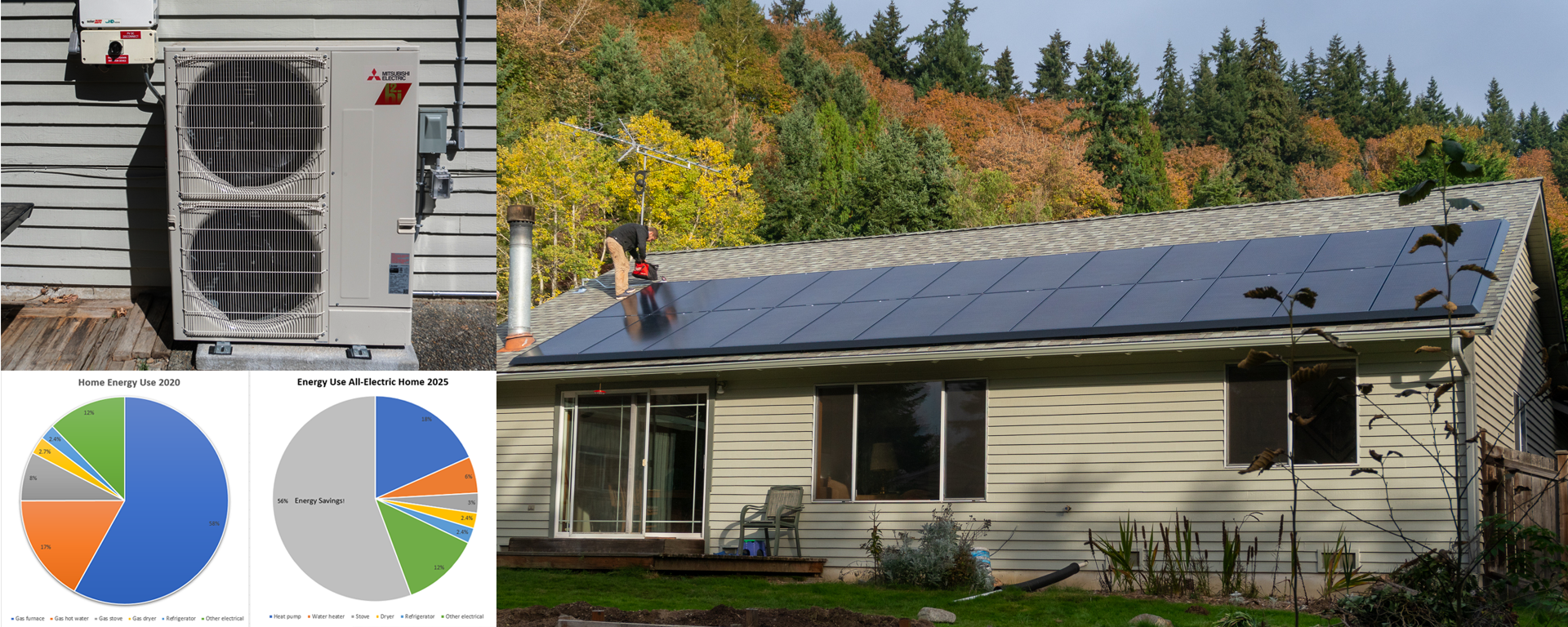
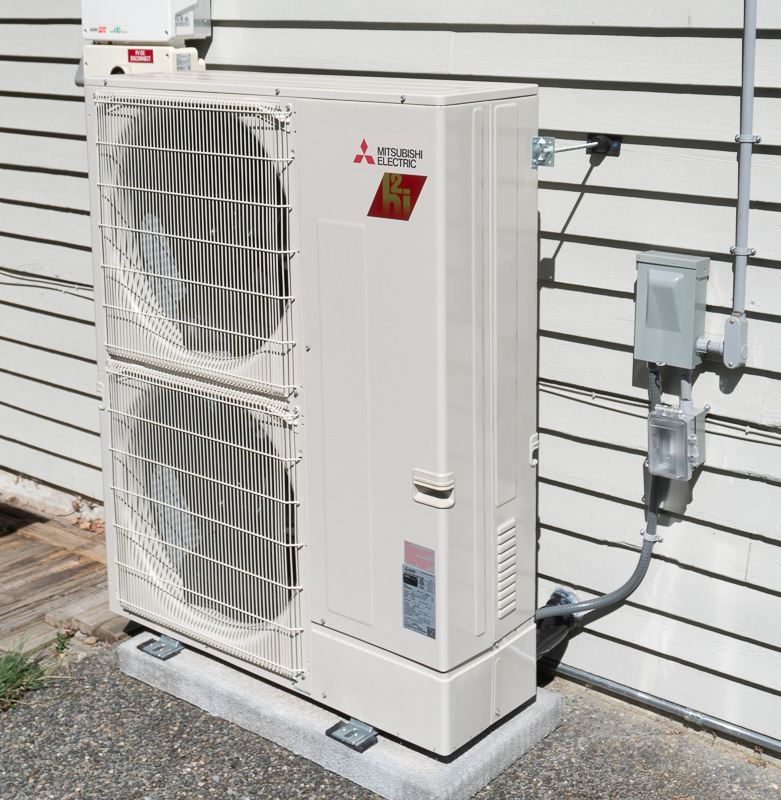
In 2024, Energy Smart Eastside (Bellevue, Kirkland, Redmond, Mercer Island, Sammamish and Issaquah) began offering $6000 to replace a gas furnace with a heat pump, which runs solely on electricity.2 That incentive derives from the 2021 Washington State Climate Commitment Act, so it’s likely to be available for some time. Additionally, a federal tax credit of $2000 is available thru 2025, and Puget Sound Energy has a $600 rebate.
Heat pumps for space heating have a reversing valve that allows them to cool as well as heat, a good we wanted due to increasingly hot summers. We decided to act. For our situation, it made sense to replace our remaining gas appliances all at once. We had three Energy Smart Eastside-approved installers bid on replacing both the gas furnace and old water heater together. Installation took less than a day, on April 4, about a month after we awarded the work. We donated the gas furnace and gas dryer, which had some life left,3 to Habitat for Humanity. The gas water heater was carted off for scrap.
Now August, it’s early days, but we’re impressed with the new kit. A big concern was neighbors hearing the heat pump outdoor unit, but when asked they’ve said no. The indoor air blower is quieter than the old gas furnace as well. The heat pump water heater hums when operating in the garage, but we can’t hear it inside the house. Since the summer garage air is warm, the water heater is efficiently channeling that warmth into hot water, for now with little energy use. I am a bit concerned come winter, though, when efficiency will drop. The water heater is a hybrid; when garage temperature dips below 37F, water heating switches from heat pump to electric element(s).
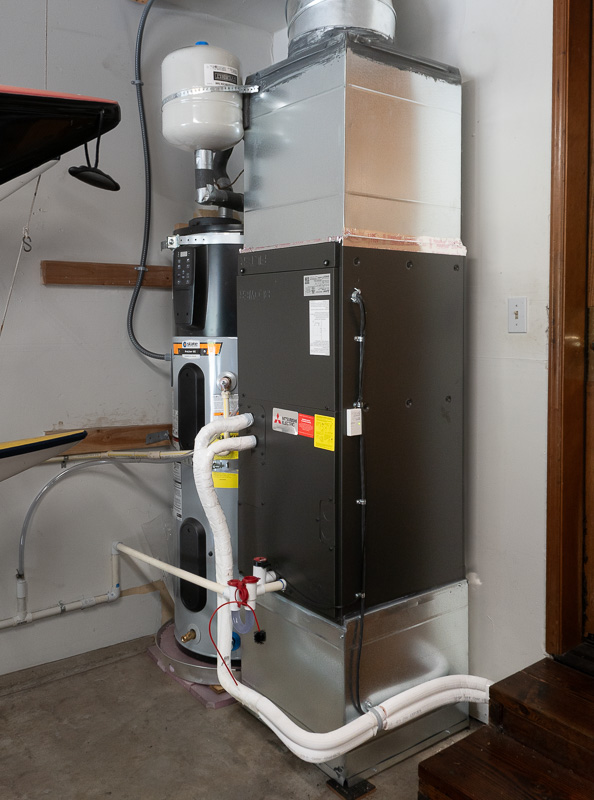
So far, through the end of July, I can say the AC load on our electric use is almost negligible. Importantly, our summertime routine has not changed from our days of no AC. Our home has excellent north-south ventilation through windows and doors, and a ventable skylight. We take full advantage. In general, we first check the forecast. If that’s above 78-80F, we open windows in the evening and more so in the early morning, and occasionally engage a fan to further cool the interior. By late afternoon on hot days, when the indoor thermostat reaches about 76F, the AC is turned on manually, thermostat set at 75F.
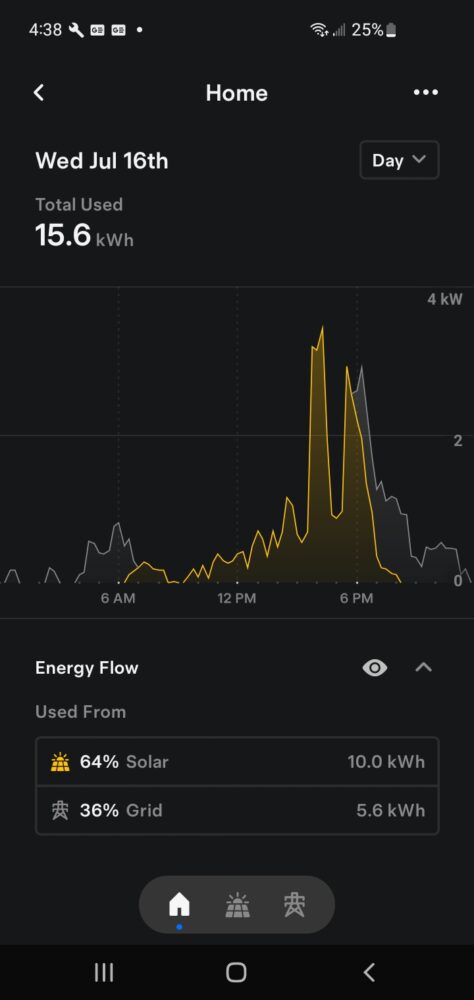
Reviewing the April to July outdoor temperature data and our call for AC, there were days (6) when the max outdoor temperature reached 85F or more; these are the only days the AC operated. On the hottest day, July 16, outdoor temperatures soared to 93F and we ran the heat pump from about 3pm-8pm.5 The heat pump used no more than 7 kWh that day.6 I would put our total kWh expenditure for AC, April thru July, at 30-35 kWh. At $.15/kWh that’s about $5.
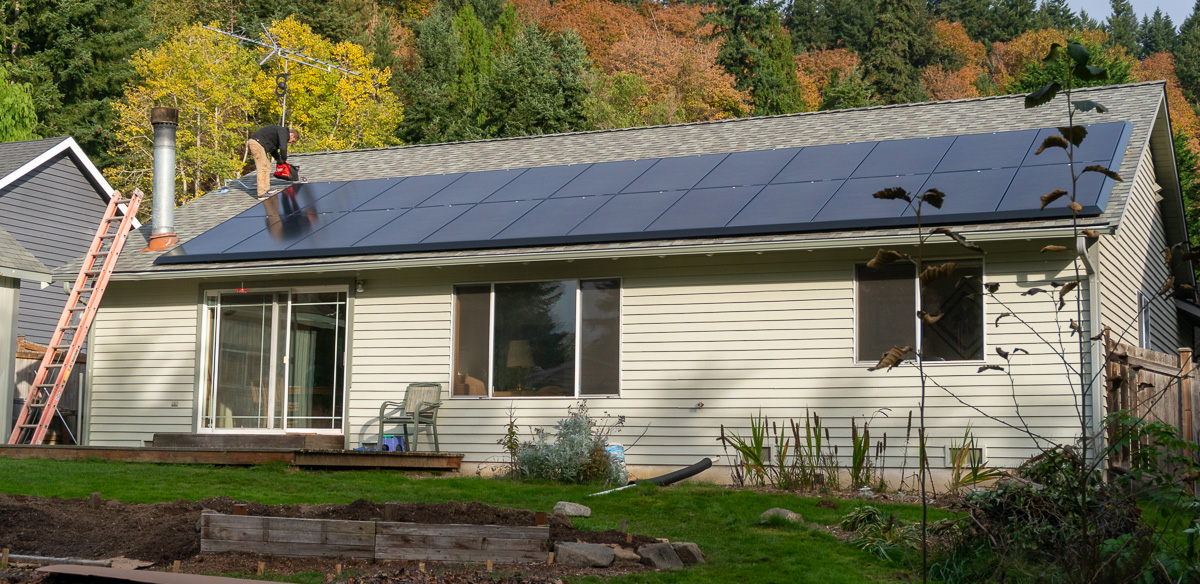
Winter will be a bigger challenge. But, some good news. As many of you know, Washington’s current law regarding solar requires “net metering”: the electric utility (PSE) records solar production out to the grid, and of course, electricity delivered into the home. For us, about seven months of the year we export more than we import. We expect to “bank” enough summer kilowatt-hours to get us through the winter and almost to April. Then—with the lengthening days—our solar production will again exceed the needs of our home.
More about our 2020 solar installation can be found here: https://garyluhm.net/western-washington-rooftop-solar/
Note: Sad to say, many people in this country have been conned into thinking solar isn’t an option, only (government-subsidized) dirty energy is. There are many ways in which solar works (it started years ago with the space program and consumer items like pocket calculators). In many parts of the USA—and especially the world—it has become the cheapest energy source, producing clean, highest-quality energy: electricity. Solar is also the quickest to install. USA is a brittle country to rely on fossil fuels. Solar energy is energy security. On USA’s current path, this will not end well. I’m happy to say in closing, though, there is a path forward. The move to electrify buildings, machinery, much of transportation, and more—fueled in part by solar—over time will factor hugely toward (pick your concern) real national security, energy independence and/or a way forward in dealing with the climate crisis.
I wrote a follow-up regarding all-electric homes using less energy. In our case, 56% less: https://garyluhm.net/all-electric-homes-use-less-energy/
Gary
Footnotes:
2Over time, as electricity generation comes more and more from renewables, the carbon footprint of electrically-run equipment decreases.
3The furnace and gas dryer were seven years old, in good shape–you could say lightly used–with quite a bit of life left. Normally, it makes economic sense to replace appliances only at or near end of life. Our local climate, however, is not the same as a few decades ago. Summers that were tolerable without AC are increasingly not so. Scary that our changing climate isn’t a “new normal”, as some say. We’re in transition toward further warming, with probable catastrophic tipping points.
4Technically, resistant heaters aren’t really inefficient. Almost all the electricity (98% or so) converted to heat is delivered, with space heating, directly to the air. The heat pump, however, typically operates averaging 300% efficiency, or more, because it MOVES heat using a refrigeration cycle (and does not, BTW, violate the laws of thermodynamics!).
5For PSE Flex events, which will occur when high or low temperatures stress the grid, we will adjust our strategy. For example, for a summer event, we would likely cool our home beforehand and shut off air conditioning and other appliances and then coast through the event. Lowering use during peak demand saves everybody’s bottom line. PSE offers modest financial rewards for cutting back during Flex events, see https://www.pse.com/en/rebates/PSE-flex/flex-rewards/
6I calculated this by eye-balling the area under the curve (kW x h = kWh) from the 3-8 pm spike in the solar app’s day graph (left), which tracks solar production and utility input in 15 minute intervals.
Good to hear from you and congratulations! I made a point to advocate for ‘free air’ cooling when I was consulting on building energy analyses decades ago. Today, we automatically open the cross-ventilation doors as soon as the outdoor temperature drops on warm and hot days. However, it gets scary when the outdoor temperature does not significantly drop by 8 or 10 PM.
We have very efficient building-wide assisted heating/cooling for our condo unit and an electric hot water tank that is rated to lose only 1 degree F per day if/when the power fails. Maybe someday I’ll get back on the board and we will install solar on the condo roof. We have a great southern exposure but few residents and no board members with any applicable background. Everyone is afraid of compromising the roof. They don’t know and they don’t trust me for what I know.
My nostalgia, dating back decades, is having helped walk the land collecting nature’s indicators, locating anemometer sites to collect 24/7/365 data, and eventually seeing the huge wind farm installation just this side of Ellensburg. In between, I consulted with the engineering firm with the contract to determine the most advantageous density of turbines to avoid ‘wasted wind’ and also avoid a canopy effect. They asked me how they could clearly track the wind from the wind turbines in Goldendale. I told them to get purple smoke grenades like we used in Vietnam to pinpoint landing zones for evacuation helicopters (major rotator winds). It worked perfectly. They videoed the smoke trails to calculate the best density placement of multiple turbines. That research/publication is likely used for every wind farm today. I’m sure my name is not mentioned. 🙂
Curtis I had no idea you did most of this stuff. Coffee soon!
Gary thank you for posting this and sending it to me. Congratulations on your home electrification! It’s encouraging to hear of anyone taking climate change seriously. I wish we had taken advantage of solar panels when we received a quote ten years ago, when the rebates were in place. Our roof is now in the “5 years left” zone. However, we replaced our gas furnace with a high efficiency heat pump 2 1/2 years ago and I love having A/C in the summer and a more consistent temperature in the house in winter. We usually set the cooling at 76 in the summer and heating at 67 or 68 in the winter. We have never had a day when the heat pump couldn’t keep the house warm in the winter, but we did observe that turning the set point down to 60 at night doesn’t make sense because in the very cold weather it can’t heat the house back up in the morning quickly enough.
We need a new cooktop (still using our 1991 electric version which is terribly slow) so next in our plan is an induction stove. I’ve never had a gas stove, so I think that the induction stove will be a huge improvement!
Would you mind if I sent your link to my co-volunteers at PCA? (People for climate action) I think it’s a great write-up of your experience with electrification.
I hope that you and Kate are both well. The neighborhood isn’t the same – Ross and his partner Kat moved and sold their corner house with all of the beautiful old conifers. We are bracing for the umpteenth tear-down and rebuild – ugh!
Best to you,
Sarah
Sarah You’re so right that keeping climate in the conversation is important! The not-so-slow-anymore moving existential threat that doesn’t feel so for most of us, but the consequences are dire if we don’t act, and act now. Sorry to hear about another teardown in the old hood.