
Regarding homes, gas delivers energy for space and water heating—the biggest energy users—plus food prep and, less commonly, clothes drying. Big energy reductions occur by replacing space and water heating with heat pumps.2 Cracking the climate crisis means renewables, not fracking. Heat pumps play a huge role.
Electrically driven, heat pumps move heat from a source to a sink, to both heat and cool a home. When heating, a compressor moves heat between outside and inside heat exchangers; the moved heat is multiples greater than the input work. A reversing valve allows the heat exchangers to switch roles and provide cooling. Today’s advanced heat pumps are replacing gas furnaces, gas water heaters and gas clothes dryers in residential homes. In 2024, for the third year in a row, heat pumps outsold gas furnaces in the USA.3
Induction stoves, as well, are much more efficient4 compared to gas stoves, and a tad more efficient compared to older-style electric stoves. Gas stoves pollute indoor air.5 Induction stoves heat faster, are safer, and they don’t pollute inside the home.
Our Home Illustrates
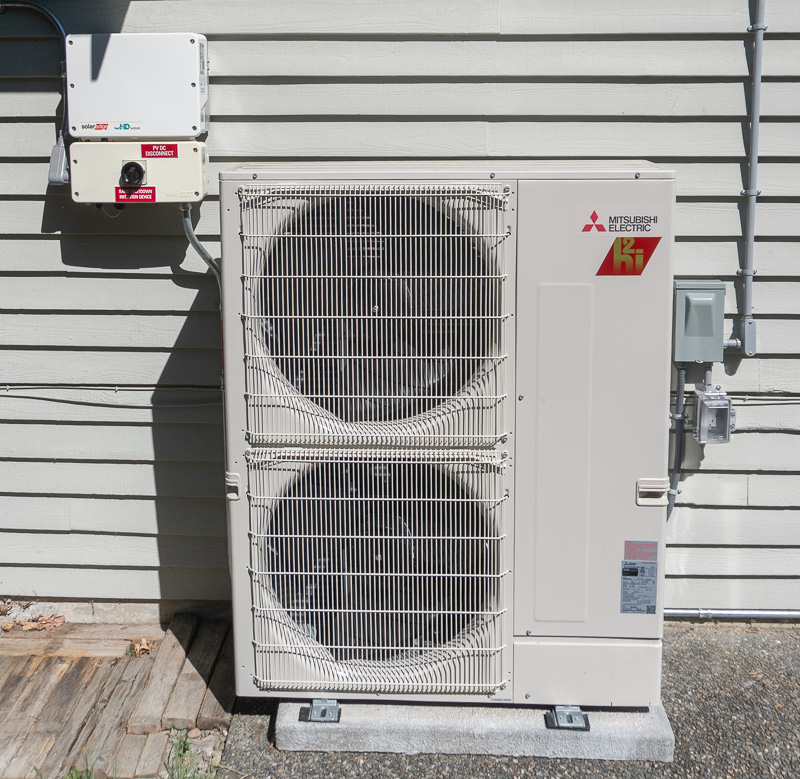
We installed twenty-four 340-watt panels, 8.16 kW, in late 2020. We would phase out gas, and add more panels if we got an electric car. Predicted yearly output was 8788 kWh using PVwatts. Our actual average for four years (2021-2024) was 9,377 kWh.
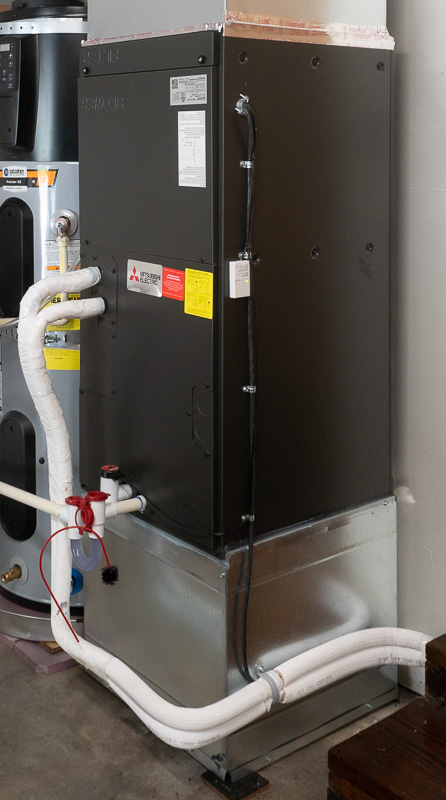
Our quest to fully electrify resolved in April, 2025. We now have a Cold Climate6 heat pump for heating and air conditioning, a heat pump for hot water and an induction stove. Our new electric clothes dryer is not a heat pump; as we are a two-person household, we simply don’t use the dryer enough to justify the extra cost of a heat pump dryer.
Energy Savings
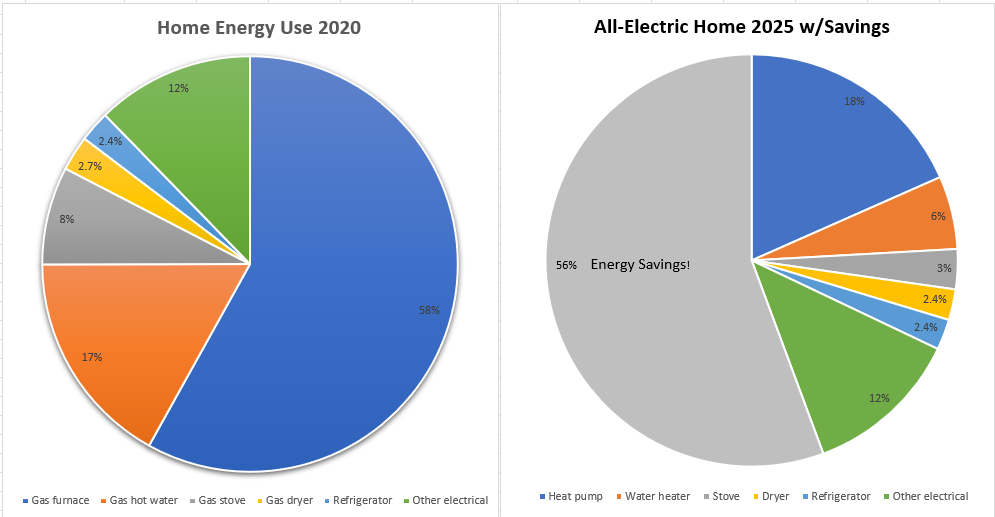
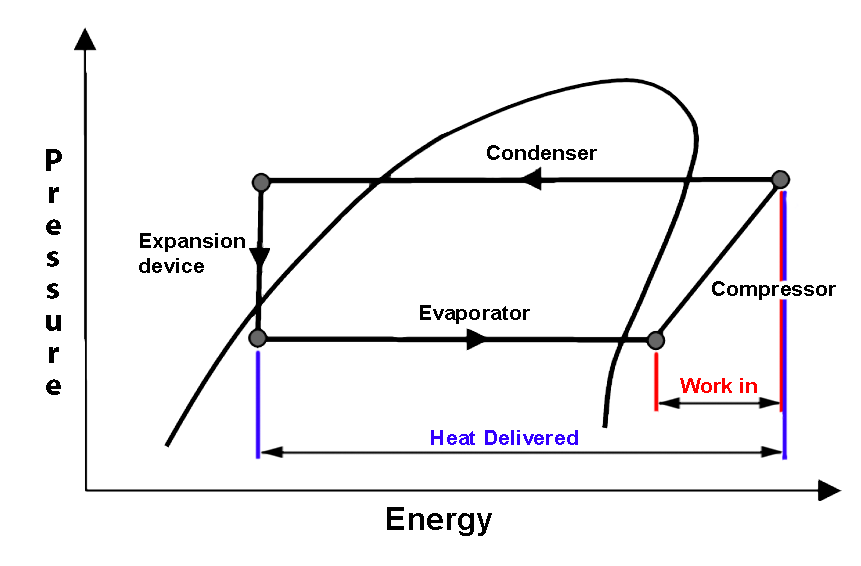
Similarly, the gas water heater consumed 17% of home energy, with an efficiency of about 62%. I assumed an overall heat pump water heater COP of 2.3.8 Water heating total energy then declines from 3,379 kwh to 1,147 kWh.
The induction stovetop, too, saves energy compared to gas, as does the electric oven compared to a gas oven. I lumped the stovetop and oven together, calculating a reduction of 1,526 kWh to 629 kWh.4
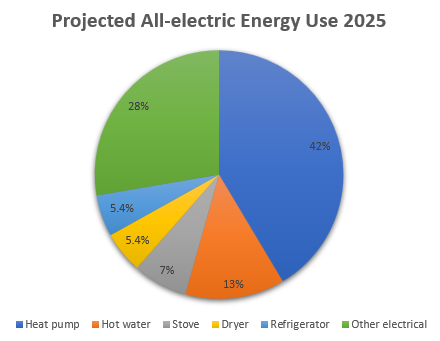
A not insignificant switch to all-electric is ditching the fixed hook-up gas charge, $14/month, or $168/year.
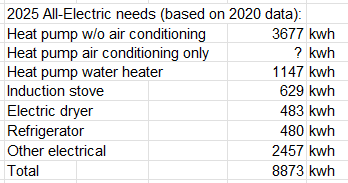
It is plausible that we’ll use up our “banked” electricity come March before we start re-filling again in April as solar days lengthen. I’ll report on that then.
Additional Notes
As a thought experiment, suppose we had no solar, and we compare utility bills before and after using 2025 rates and the same efficiency assumptions. That analysis yields a yearly cost of $1,662 before conversion and $1,603 for all-electric, a trifling 3.7% “win” for electric, against a 95% efficient furnace, etc. What if the old furnace had been the more common 80%? Energy cost for the before conversion gas home would then be $1,779, 10.0% more compared to our all-electric home.11
Other notes: Today’s grid electricity isn’t clean. With solar, we could argue no greenhouse gas emissions.12 But what if no solar? What if fossil-fueled power plants were the electric source? Old coal plants are 30-33% efficient; combined-cycle gas plants reach 60%; standard gas thermal plants 40%; peaker gas 20-35%. With PSE, the mix of fossil fuels and renewables currently is roughly 30% hydro, 22% wind, 30% gas, 18% coal, <1% solar and nuclear (ignoring PSE purchased energy). This yields an average of .745 lb CO2/kWh for grid generated electricity using DOE data (and ignoring transmission, equipment manufacture and other greenhouse gas costs like fracking energy and methane leaks). Running the numbers, greenhouse gas emissions for our all-electric (no solar) home would be 26% less than the old home assuming a roughly 52% clean grid for the mix above. But the grid gets better with time. By the end of the 15-year heat pump life, the PSE grid could be closer to 65% clean; greenhouse emissions would then be down 61% (I assumed retiring all coal by then).
What if you’re just considering replacing a 95% efficient gas furnace with a heat pump within PSE service territory. For energy cost, the difference isn’t much. Using a COP of 3, energy cost with gas would be 4.4% less than with a heat pump. In mild Seattle, though, comparing the heat pump Heating Seasonal Performance Factor (HSPF) might be a useful indicator. With our Cold Climate heat pump HSPF, 13.6 Btu/watt (COP = 3.99), the cost would be 21% less for the heat pump. The actual number may be between the two, with cost differences small.13 Regarding greenhouse gases—again in PSE territory—the heat pump reduces greenhouse gases by 41% now and an estimated 68% toward the end of its life. FYI, a RMI study predicted a 91% CO2 emissions reduction over the 15-year life of the heat pump for Washington State as a whole, compared to gas. Electric use carbon footprints will continuously improve year-by-year as the grid moves toward renewables.14
Gary
Former Energy Engineer
Volunteer Energy Smart Eastside
Footnotes
1Fossil fuels create electricity in power plants, but efficiencies are limited by thermodynamics. Fossil-based power plants pollute the air with smoke and greenhouse gases and generally consume large volumes of water.
2If you’re a home owner and live in Bellevue, Kirkland, Redmond, Mercer Island, Sammamish or Issaquah, you may qualify for up to $8600 in incentives to install a heat pump, thanks to Energy Smart Eastside.
3 According to Rewire America , and data at the Air Conditioning, Heating, and Refrigeration Institute (AHRI).
4 Induction stoves are 85-90% efficient; gas stove efficiency is 33%. Electric oven efficiency is 74%; gas oven efficiency 40%. That said, gas is far cheaper per Btu than electricity, with potentially lower operating cost.
5Gas stoves emit unhealthy levels of nitrogen oxide (NO2), according to a Stanford study on indoor air pollution. NO2 increases the likelihood of asthma in children. And gas stoves leak methane, a deleterious greenhouse gas, and benzene, a carcinogen. Be sure to vent the exhaust if you have a gas stove. If you’re not ready for and induction stove, consider induction with a single-burner model, which sell for less than $100. We did that before we bought our induction stove. Note that induction only works with cookware that contains iron, like cast iron or stainless that is magnetic. Test cookware with a magnet if you’re unsure.
6Cold Climate heat pump air handlers have no (inefficient) back-up resistance heat elements. Instead, these modern-day heat pumps use a variable-speed compressor and fan drives to increase capacity as the temperature drops and to smooth performance. The rated COP for our particular heat pump is 4.2, and the Heating Seasonal Performance Factor (HSPF) is 13.6 Btu/watt, equal to a COP of 3.99. Actual field performance will be less than these numbers.
7The conversion of therms to kWh is best understood using British Thermal Units (Btu). One Btu is the energy required to raise one pound of water 1o Fahrenheit. A therm is 100,000 Btu. A kWh is 3,412 Btu. Thus, to convert our year of gas heating, 396.5 therms to kWh, the conversion is 396.5 therms x 100,000 Btu/therm / 3412 Btu/kWh = 11,619 kWh.
8Archaically, the old water heater had no electric input, but instead relied on a continuously-lit pilot light. Spring, summer and fall, the heat pump water heater may have a COP of 4 or more, but the unit is a hybrid—resistance heat kicks in when the temperature drops below 37oF. Winter COP may be no better than 1.5.
9Washington State requires electric utilities to offer net metering. With it, the electric meter records incoming kwh as well as outgoing kwh sent to the grid by the solar panels. The “net difference” accumulates (is “banked”) in the sunny months, for winter use.
10I ignored the extra electrical load that will occur from air conditioning. Thru 8/20, the summer of 2025 felt more normal for temperature (not rainfall), without significant heat domes, and we hadn’t had that many 85F+ days when the air conditioning is really needed. In any case, it’s shocking to see how little energy was used thru 8/20 this summer, not more than 100 kwh, or the equivalent of $15. I must add, emphatically, that we still open up windows and doors to pull down the interior temperature every night the forecast is for uncomfortably high (>80F) temperatures, a good practice for everyone.
11DOE is set to phase out 80%-efficient furnaces in 2028 if the Dark Lord doesn’t nix it. Additional installed cost for a 95%-efficient furnace compared to 80% is $1000-$1200.
12Here I’ve ignored the energy needed for solar panel manufacture and disposal. Solar panels are, however, using increasingly less materials, with less silicon, longer lifespans, and easier recycling.
13Heat pumps continues to improve, including new refrigerants. In 2026, refrigerant R-410A will be replaced by R-32 or R-454B in the US. These new refrigerants have less global warming potential than the R-410A, the most common heat pump refrigerant currently used here. R-32 is ≈ 10% more efficient than R-410A, is non-proprietary and is commonly used residentially in Europe and elsewhere. R-454B is the better choice considering warming potential, but is less efficient than R-32.
14Worldwide, solar is now the cheapest electricity in most places, following a downward cost curve much like Moore’s Law for computers, a cost trend that has not yet ended. A chief ingredient of a solar cell is sand (silicon), and new cells are using less and less of even that. Large scale battery storage (LSBS), which is stabilizing the grid, are following an even more rapid downward trend, with cost decreasing from $1400/kWh in 2010 $115/kWh in 2024 for the once-expensive lithium-ion battery packs; even less costly battery technologies are available.
Well written Gary. It’s an excellent article with facts in a good balance of technical and lay terminology. I spent the last 20 years of my teaching career urging my engineering students to consider entering the world of energy engineering. The benefits are more than just a promising career. We are draining down the Earth’s battery of stored ancient sunlight in the form of fossil fuels faster than it can be renewed. The impending crisis will come long after I am dead, but I’ll die knowing that I did, at least, something.
It’s not very easy having a positive outlook toward the future these days, but your article helps. Cheers, my friend.
PS, Our solar contractor is expected to have our installation completed by late October. We should achieve 50-70% of electrical consumption as PV. It’s a start!
Les, thanks so much. I’m reading Bill McKibben’s book “Here Comes the Sun”. So inspiring. Incredible how fast the cost of solar has come down, obsoleting fossil fuel for new electricity, with other uses to follow. The world is installing a 1 GW nuke plant worth of solar every 15 hours! In 2024, 93% of new generating capacity in the USA came from a combination of solar, wind and batteries. Wow!
Good luck with your solar project.