
In the late 90’s, I seized on a tip from a Tim Fitzharris book,1 where he stated he used a 500mm f4 lens to photograph wildflowers. He reasoned this use would produce something different, so unlike the then-popular 4×5-inch large-format cameras. Different indeed. Different as well from a 100mm macro lens that grounded the passions of 35mm-film wildflower buffs. Large-format could never capture a narrow field-of-view, and especially couldn’t capture the bokeh achieved with a super-telephoto. The macro lens had some merit for that, and especially for nailing intricate detail on dewy mornings. But the fast telephoto made magic delivering just a subject’s essence, a pleasing look when implemented well.
I began using my 500mm f4 for wildflower portraits, with extension tubes attached for closer focus, in 2000.2 The results astonished. You just never knew what lurked in the viewfinder until you looked through that big-lens glass close up. Tiny camera moves would make or break the shot.
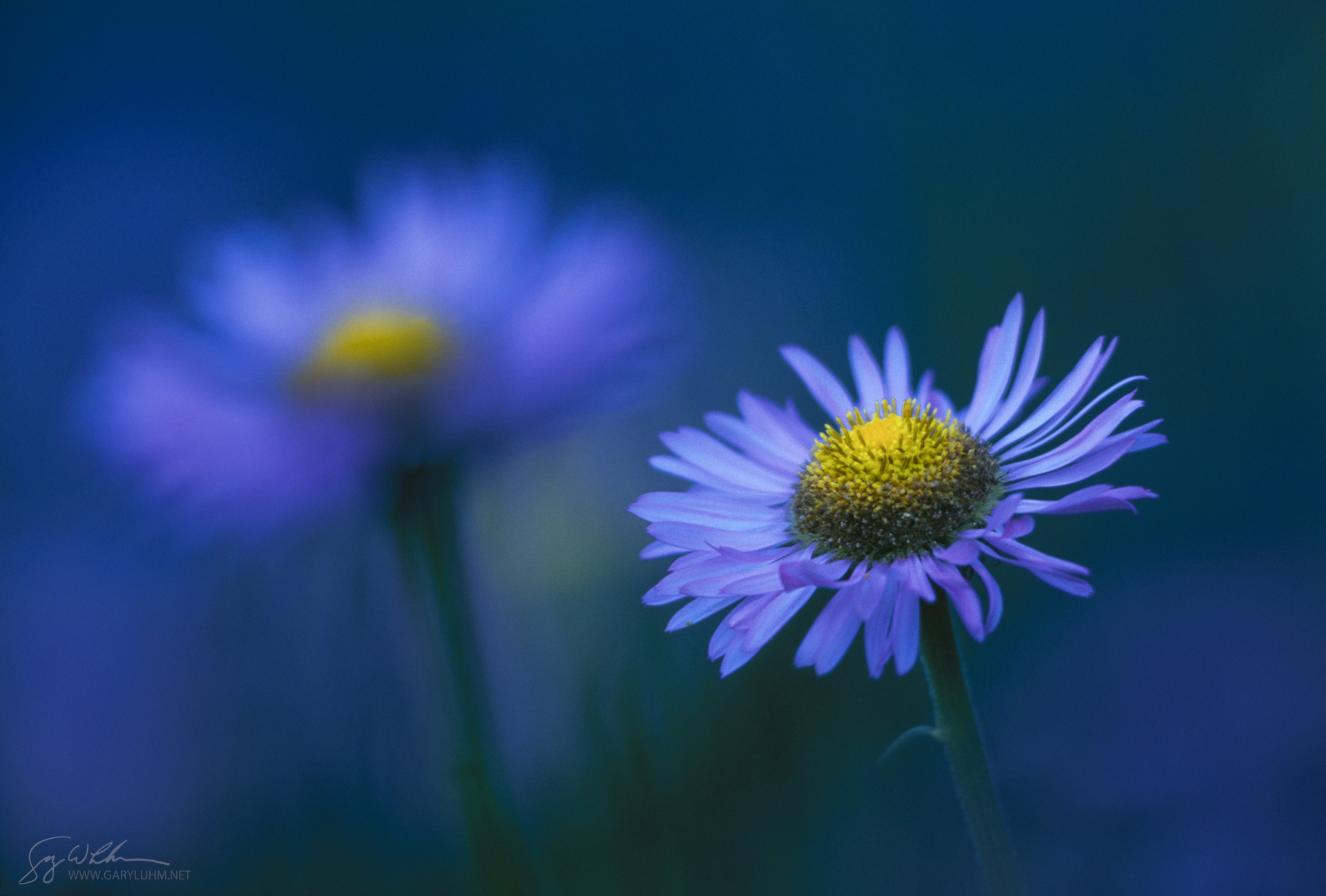
Compositionally, the above image illustrates juxtaposition, using two flowers, one in- and one out-of-focus. A viewer’s eye lands quickly on the in-focus flower, but juxtaposition encourages movement as the eye moves to the out-of-focus flower and then back.3 The 500mm f4 assures a tight field-of-view, a narrow depth-of-field and so much bokeh. Potential competing elements here dissolve into a wash of greens, yellows and blues. I was also shooting thru at least one foreground flower, which effectively blurred the in-focus flower’s stem, encouraging mystery.
The flowers are Mountain Daisy (erigeron peregrinus), photographed in an inconspicuous roadside ditch, along the Paradise Valley Road near the Paradise River, Mt. Rainier National Park.
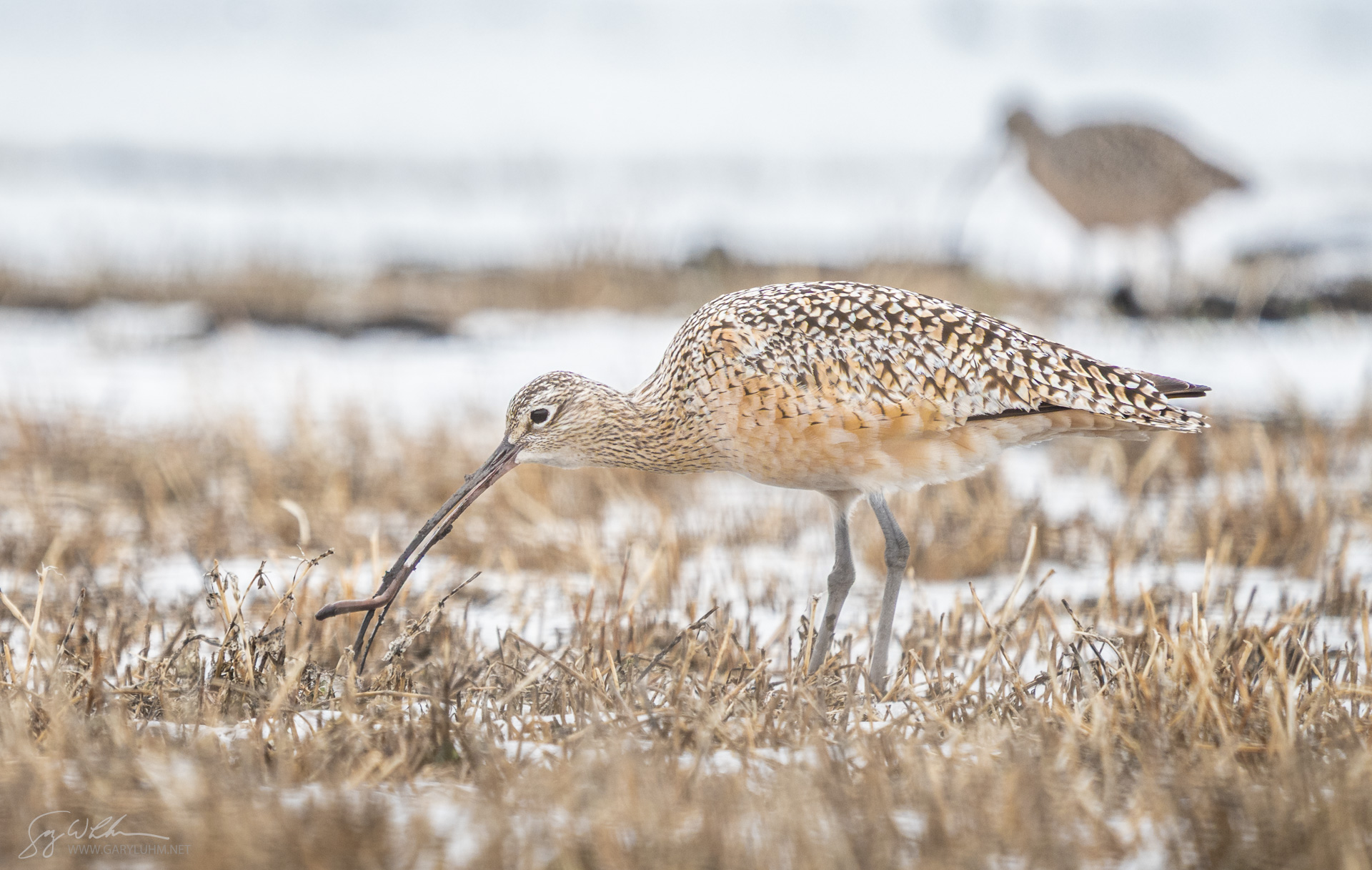 Regarding juxtaposition, the technique can be successfully used with many subjects. At right is an effective use with a pair of Long-billed Curlew, where⸺in addition to promoting eye-movement⸺the pairing makes one feel there are more than just two migrating birds in the snowy field, a comforting thought.
Thanks for looking.
Gary
1Probably the Sierra Club Guide to Close-up Photography in Nature, Sierra Club Books, c1997.
2I bought the lens to photograph kayak surfing, and wildlife. Purchased in 1998, photographing birds, other wildlife and then wildflowers became the biggest uses. I learned to photograph kayak surfing on the water from my kayak with a 300 f4, which was also something different.
3Note that odd numbers, like the number three compared to two or four, are a generally better compositional choice then even numbers. Odd numbers create visual appeal thru asymmetry and greater eye movement.
Gary: I get it. You’ve got it. One of my very early experimentation/learning shots in monochrome had the wild grass in bloom in the foreground out of focus, me (shot by my partner) in crisp, from the side, focus and the background nicely out of focus. The ability to manage what viewers would absorb was probably the biggest hook that has kept me dabbling in photography ever since.
I found I could do much the same thing in the lab in biology by removing the microscope eyepiece and shooting down the tube. I managed some amazing images of developing critters with open circulatory systems. One could see, frame by frame, the pumping of what served as a heart without the veinous system.
Hi Curtis. Creative use all. Thruline coffee soon.
Gary, Regarding the Image…….Picasso!!!!! I remember, with GREAT emotion you teaching me the technique near the 4th crossing
Paradise Valley Road, in the ditch. Thank you!! Nice Guys finish first…….your there!!!
All the Best, Andy
Andy, thanks so much. Parking by the bridge and hiking at dawn for Mazama Ridge or especially the Skyline Trail above the falls was such a treat: fabulous views, elk, spotted sandpiper, monkeyflowers!